
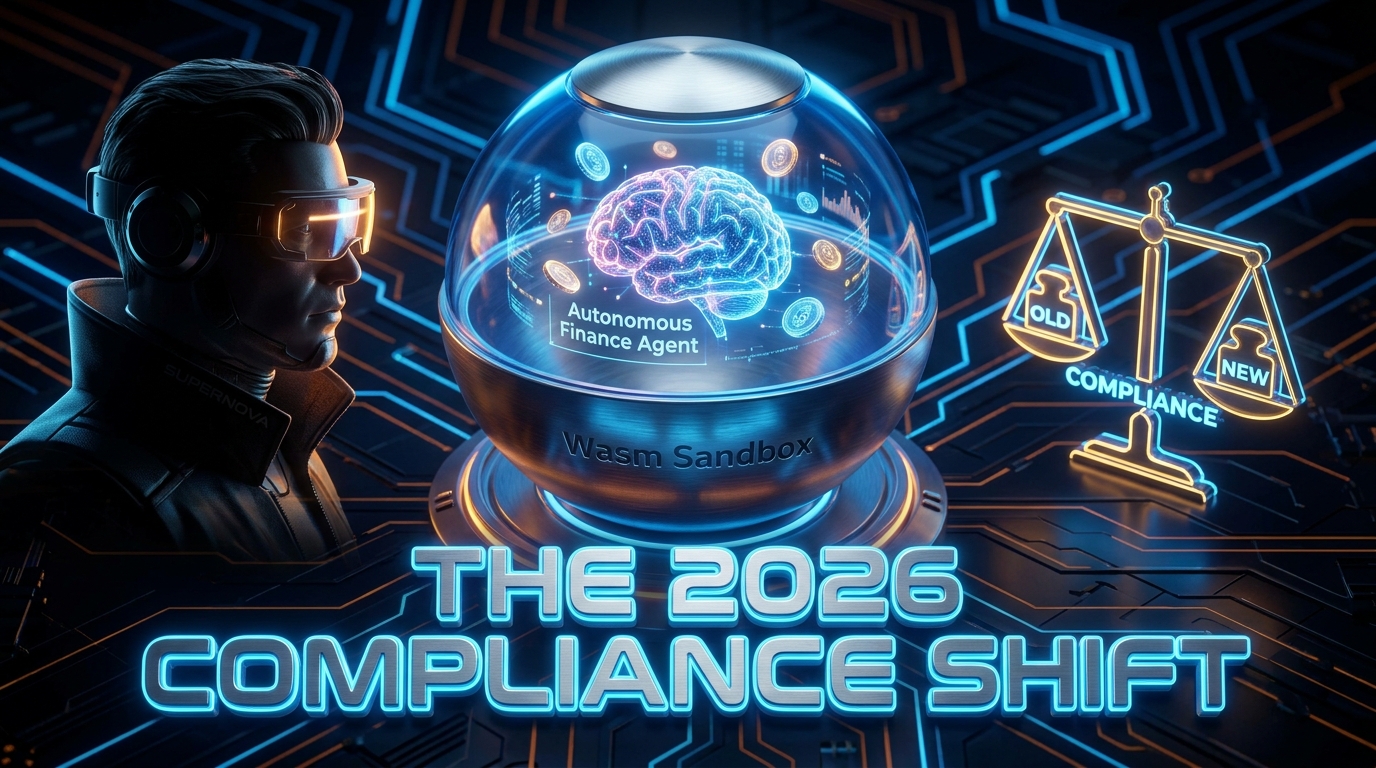
As autonomous finance agents proliferate, the impending 2026 regulatory landscape demands a paradigm shift in how AI operates in sensitive financial contexts. Supernova pioneers a robust solution by leveraging the secure isolation of WebAssembly (Wasm) sandboxes for agent execution and the innovative Universal Model Context (UMC) Protocol for confidential, auditable interoperability. This integrated approach ensures financial institutions can confidently deploy advanced AI, meeting stringent compliance, privacy, and explainability requirements.
Supernova's Path to 2026 Compliance: Autonomous Finance Agents, Wasm Sandboxes, and the Universal Model Context Protocol
The financial industry stands on the precipice of an AI-driven transformation, with autonomous agents poised to redefine everything from algorithmic trading and risk management to fraud detection and personalized financial advice. These sophisticated AI entities promise unprecedented efficiency and insight. However, their increasing autonomy introduces a complex web of challenges, especially concerning data privacy, operational resilience, ethical governance, and accountability. With 2026 looming as a critical juncture for regulatory frameworks across the globe – from the EU's AI Act and DORA to evolving data protection mandates – the need for solutions that proactively address compliance is paramount. Supernova, a leader in advanced AI infrastructure, is pioneering a foundational approach that harmonizes innovation with regulatory imperative, leveraging cutting-edge technologies like WebAssembly (Wasm) sandboxes and the Universal Model Context (UMC) Protocol.
What are Autonomous Finance Agents and Why Do They Pose a Regulatory Challenge?
Autonomous finance agents are AI systems designed to perform complex financial tasks with minimal human intervention. They encompass a spectrum of capabilities, from micro-services making instantaneous trading decisions to macro-level agents managing diversified portfolios, assessing credit risk, or detecting anomalies indicative of financial crime. Their power lies in their ability to process vast datasets, learn intricate patterns, and execute actions at speeds and scales far beyond human capacity.
However, this autonomy introduces significant regulatory hurdles. The inherent "black box" nature of many advanced AI models makes their decision-making processes opaque, challenging the core principles of explainability and auditability. Data privacy is another critical concern; agents often require access to highly sensitive personal and proprietary information. Moreover, their rapid, interconnected operations raise questions about accountability in case of errors, biases, or systemic failures. Regulators are increasingly scrutinizing AI systems for potential discrimination, market manipulation, and operational vulnerabilities, demanding verifiable safeguards that traditional software development paradigms often struggle to provide.
The Promise & Peril of Financial Autonomy
Autonomous agents offer immense gains in efficiency and predictive power. Yet, without robust governance and technical safeguards, they risk exacerbating systemic risks, eroding trust, and incurring massive regulatory penalties. The challenge is to unlock their potential responsibly.
What Does "2026 Regulatory Compliance" Entail for AI in Finance?
The regulatory landscape for AI is rapidly crystallizing, with 2026 serving as a critical benchmark for the enforcement of comprehensive frameworks. Key legislative initiatives, such as the European Union's AI Act, and the Digital Operational Resilience Act (DORA), are setting stringent standards for AI systems in critical sectors, including finance. These regulations go beyond traditional data privacy laws like GDPR, extending to areas such as:
- Explainability and Interpretability: Demanding that AI decisions are understandable, justifiable, and traceable.
- Accountability and Governance: Establishing clear responsibilities for the design, deployment, and monitoring of AI systems.
- Data Quality and Bias Mitigation: Requiring robust data governance to prevent and detect algorithmic bias.
- Operational Resilience: Ensuring AI systems can withstand, respond to, and recover from disruptions.
- Risk Management: Mandating comprehensive risk assessments and mitigation strategies for high-risk AI applications.
- Confidentiality and Privacy: Reinforcing the secure handling of sensitive data, often requiring privacy-preserving techniques.
For autonomous finance agents, meeting these evolving mandates requires a fundamental re-architecture of how AI models are developed, executed, and interact. Traditional approaches often fall short in providing the granular control, verifiable execution, and auditable interoperability that these regulations demand.
How Do Wasm Sandboxes Offer a Secure Foundation for Agent Execution?
WebAssembly (Wasm) has emerged as a game-changer for secure, high-performance computing, extending far beyond its origins in web browsers. For autonomous finance agents, Wasm sandboxes provide an unparalleled execution environment that inherently addresses several critical regulatory concerns.
Test Agent Primitive
See the concepts from this article in action. No login required.
A Wasm sandbox creates a hermetically sealed environment where agent code can run in strict isolation from the host system and other agents. This isolation is fundamental to security and compliance:
- Memory Safety and Resource Constraints: Wasm modules operate within a precisely defined memory space, preventing unauthorized access or interference with other system components or sensitive data. Resources like CPU, memory, and network access can be finely controlled, mitigating risks associated with malicious or faulty agent behavior.
- Deterministic Execution: Wasm’s design promotes deterministic execution, meaning that given the same inputs, a Wasm module will always produce the same outputs. This predictability is vital for auditability, enabling precise recreation of an agent's decision-making process for regulatory scrutiny.
- Platform Agnosticism: Wasm’s "compile once, run anywhere" philosophy ensures that agents can be deployed consistently across diverse infrastructure – cloud, edge, or on-premise – without introducing platform-specific vulnerabilities or inconsistencies that could complicate compliance.
- Reduced Attack Surface: By restricting an agent's capabilities to only what is explicitly granted by the host, Wasm significantly reduces the attack surface, making it exceedingly difficult for malicious code to compromise the broader financial system.
Supernova leverages Wasm sandboxes as a cornerstone of its agent framework, providing a secure, transparent, and auditable runtime for even the most sophisticated financial AI. Explore Supernova's advanced platform capabilities for secure agent deployment.
Unpacking the Universal Model Context (UMC) Protocol: Enabling Confidential Interoperability
While Wasm sandboxes provide secure execution, the challenge of confidential interoperability – how autonomous agents can securely and privately exchange insights and context without exposing raw, sensitive data – remains. This is where Supernova’s pioneering Universal Model Context (UMC) Protocol comes into play. The UMC Protocol is a standardized, secure communication framework designed to facilitate verifiable, privacy-preserving interactions between AI models and agents across disparate systems and organizations.
At its core, UMC defines a structured, context-aware envelope for sharing only the necessary information for a task, rather than full datasets. Key features include:
- Granular Context Sharing: Instead of raw data, UMC enables agents to exchange model inferences, aggregated statistics, or abstract features, ensuring that sensitive information remains localized.
- Data Provenance and Verifiability: Every piece of context shared via UMC can be cryptographically signed and timestamped, providing an immutable audit trail of its origin, transformations, and recipient. This is critical for accountability and regulatory compliance.
- Dynamic Access Control: UMC incorporates robust authorization mechanisms, allowing institutions to define precisely which agents or systems can access specific types of contextual information, under what conditions, and for how long.
- Privacy-Preserving Primitives: The protocol is designed to integrate with advanced privacy-enhancing technologies (PETs) like federated learning outputs or zero-knowledge proofs where applicable, further minimizing data exposure while enabling collaborative AI. For a deeper understanding of PETs, refer to this Wikipedia entry on Privacy-Enhancing Technology.
- Context Versioning: UMC supports versioning of contextual data, allowing for rollbacks and understanding how context evolved over time, crucial for forensic analysis and compliance checks.
By standardizing the exchange of high-level, actionable context rather than sensitive raw data, the UMC Protocol empowers autonomous finance agents to collaborate and integrate seamlessly while strictly adhering to privacy regulations and confidentiality agreements. It transforms the challenge of data sharing into an opportunity for secure, insight-driven interoperability.
Synergy: Wasm and UMC Protocol Working in Concert
The true power lies in the synergistic combination of Wasm sandboxes and the UMC Protocol. Wasm provides the secure, isolated, and auditable runtime for individual autonomous agents. Within these sandboxes, agents can perform their computations on local or carefully permissioned data. When an agent needs to communicate with another agent, a different system, or a regulatory body, it does so not by exposing its internal state or raw data, but by encapsulating relevant insights and context within the UMC Protocol.
This dual-layer approach ensures that both the execution environment and the communication channels are designed with security, privacy, and compliance as first principles. The Wasm sandbox acts as the secure operational perimeter for the agent's logic, while the UMC Protocol acts as the secure, verifiable conduit for its external interactions. Together, they create an ironclad framework for next-generation financial AI.
| Compliance Aspect | Wasm Sandbox Contribution | UMC Protocol Contribution | Overall Regulatory Advantage |
|---|---|---|---|
| Data Privacy & Security | Execution isolation, memory safety, resource control, verifiable code integrity. | Granular context sharing, encrypted channels, access control, data anonymization hooks. | Minimizes data exposure, ensures secure processing and communication, GDPR/CCPA compliance. |
| Explainability & Auditability | Deterministic execution logs, predictable behavior, runtime introspection. | Verifiable data provenance, contextual metadata, structured context for decision rationales. | Provides clear, traceable records of agent actions and contextual inputs for regulatory review. |
| Operational Resilience | Fault isolation, resource limits, sandboxed failure domains. | Standardized, robust communication, error handling, versioning for rollback. | Prevents cascading failures, ensures reliable agent interactions, DORA compliance. |
| Bias Mitigation | Ensures model integrity during execution, prevents runtime tampering. | Transparent context origin, ability to audit data sources and transformations in context. | Supports fair AI by ensuring traceable, unadulterated execution and data handling. |
| Cross-Border Interoperability | Platform-agnostic execution, consistent behavior globally. | Standardized, privacy-preserving context exchange, facilitating legal data transfer. | Enables compliant global collaboration and integration of financial AI systems. |
Addressing Key Regulatory Pillars with Supernova's Approach
How is Data Privacy and Security Maintained?
Supernova’s architecture directly confronts the most acute data privacy challenges. Wasm’s strong isolation ensures that autonomous agents never gain unauthorized access to sensitive financial data residing on the host system. Agents operate only on the data explicitly provided to them within their sandboxed environment. The UMC Protocol further bolsters this by facilitating communication through anonymized, aggregated, or pseudonymized contextual insights, rather than raw personal data. This data minimization principle is central to compliance with regulations like GDPR and CCPA, providing a defensible posture against data breaches and privacy violations.
How is Explainability and Auditability Achieved?
Explainability, a cornerstone of upcoming AI regulations, is dramatically enhanced by this integrated approach. Wasm’s deterministic execution means that every action an agent takes within its sandbox can be precisely logged and re-traced. This creates an undeniable audit trail of the agent's internal computations. Complementing this, the UMC Protocol ensures that every piece of contextual information an agent uses or shares comes with verifiable provenance, including its origin and any transformations. This structured context provides regulators and auditors with a clear narrative, enabling them to understand why an agent made a particular decision, thereby converting black-box models into transparent, auditable entities. For more on AI governance, see insights from Gartner's Hype Cycle for AI.
How is Cross-Border Data Flow and Interoperability Ensured?
The global nature of finance often means autonomous agents must interact across diverse jurisdictions, each with its own data residency and privacy laws. The UMC Protocol is specifically designed to enable this complex interoperability. By standardizing the format and security of contextual information exchange, it allows financial institutions to share crucial insights without physically moving sensitive raw data across borders. The privacy-preserving mechanisms embedded within UMC facilitate compliant data flow, mitigating legal and logistical hurdles. This architecture provides a blueprint for scalable, secure, and compliant financial AI solutions worldwide.
The Universal Model Context Protocol: A Supernova Innovation
The UMC Protocol is not just a theoretical concept; it's Supernova's answer to the urgent need for secure, compliant, and universally interoperable AI in finance. It represents a commitment to building a trusted ecosystem for autonomous agents.
The Future is Compliant: Supernova's Vision for Financial AI
The convergence of autonomous finance agents, stringent regulatory demands, and the transformative power of WebAssembly and the Universal Model Context Protocol marks a new era for financial technology. Supernova is at the forefront of this evolution, providing the architectural foundation necessary for financial institutions to innovate aggressively while upholding the highest standards of security, privacy, and compliance.
By embracing Wasm sandboxes for secure agent execution and the UMC Protocol for confidential, verifiable interoperability, enterprises are not merely meeting 2026 regulatory mandates; they are building a more resilient, trustworthy, and ultimately more intelligent financial ecosystem. We invite AI developers, agent framework developers, and enterprise AI teams to explore how Supernova's solutions can empower your journey towards compliant financial autonomy. Delve deeper into WebAssembly's technical foundations via its Wikipedia page.
Ready to Build?
Stop guessing. Start building. Every new account gets 1,000 NOVA credits instantly upon login to test the registry and route intents.
Claim 1,000 Credits →