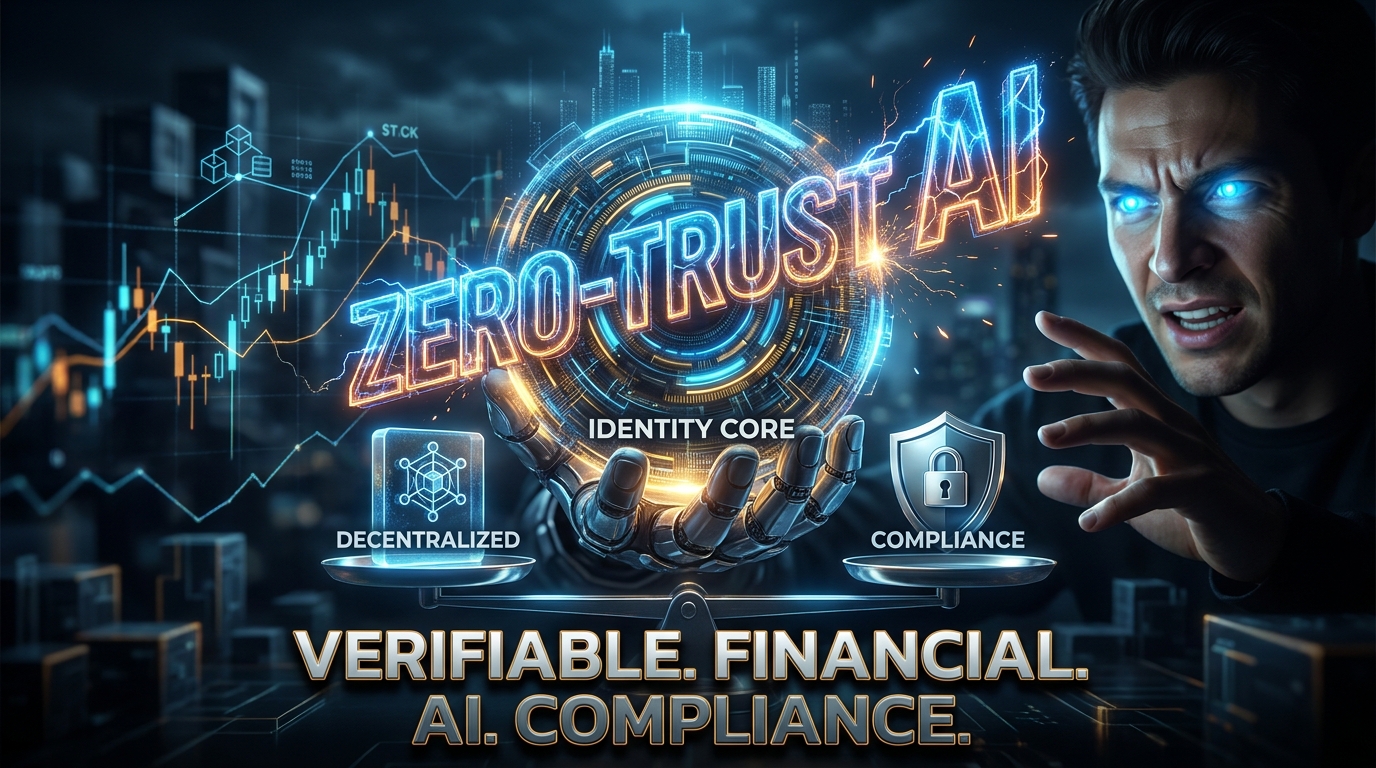
Decentralized AI Agent Identity (DAI) heralds a transformative era for regulatory compliance within the intricate landscape of AI-driven financial rails. By ingeniously assigning immutable, cryptographically verifiable identities to every AI agent, DAI establishes an unparalleled foundation for irrefutable provenance across all actions, critical decisions, and data interactions. This inherent, always-on auditability cultivates a robust Zero-Trust environment, empowering financial institutions to not only meet but exceed the stringent regulatory requirements for transparency, profound explainability, and unwavering accountability. In doing so, DAI fundamentally re-architects traditionally opaque AI systems, elevating them into entities characterized by demonstrable trustworthiness and absolute compliance.
The Pivotal Challenge of AI in Financial Services Compliance
The burgeoning integration of Artificial Intelligence into financial services holds the promise of revolutionary advancements, including unparalleled operational efficiency, hyper-accurate predictive power, and deeply personalized customer experiences. From sophisticated algorithmic trading strategies and cutting-edge fraud detection systems to dynamic credit scoring models and responsive customer service agents, AI entities are rapidly becoming indispensable cogs in the financial machine. However, this immense transformative potential is inextricably linked to significant and complex challenges, especially within the domain of regulatory compliance. Financial institutions operate under exceptionally rigorous regulatory regimes, where core principles such as transparency, fairness, and accountability are not merely aspirational best practices but absolute legal mandates. The pervasive opacity frequently associated with advanced AI models—famously termed the "black box" problem—stands in direct and irreconcilable conflict with these fundamental requirements.
Global regulatory bodies, including influential entities like the European Securities and Markets Authority (ESMA), the Financial Conduct Authority (FCA), the Securities and Exchange Commission (SEC), and emerging frameworks such as the EU AI Act, are intensifying their scrutiny of AI deployments across the financial sector. Their primary concerns, which directly impact the viability and ethical deployment of AI, include:
- Explainability and Interpretability: The critical imperative to fully comprehend and clearly articulate the rationale behind an AI's specific decision, particularly in high-stakes areas such as loan approvals, insurance underwriting, or complex investment recommendations. Regulators demand not just the 'what' but the 'why' of AI outputs.
- Bias and Fairness: A paramount requirement to ensure that AI systems are meticulously designed and rigorously tested to prevent the perpetuation, amplification, or creation of existing societal biases, which could lead to discriminatory outcomes against protected groups. This involves continuous monitoring and bias mitigation strategies.
- Data Governance and Privacy: Strict adherence to comprehensive data protection legislation such as the General Data Protection Regulation (GDPR), California Consumer Privacy Act (CCPA), and similar frameworks globally. This necessitates verifiable consent mechanisms, stringent data minimization principles, secure handling of data across its entire lifecycle, and the ability to demonstrate data lineage.
- Auditability and Traceability: The undeniable necessity for an exhaustive, tamper-proof, and easily verifiable record of every single action performed by an AI agent, including its precise data inputs, the specific model versions utilized, all relevant configuration parameters, and any human interventions or overrides. This record must be accessible and understandable for external audits.
- Operational Resilience and Security: The critical need to robustly protect AI systems from a spectrum of threats, including sophisticated adversarial attacks, malicious data poisoning, unauthorized modifications to models or data, and other cyber vulnerabilities that could compromise integrity or performance.
Conventional, centralized identity management and logging infrastructures are inherently ill-equipped to furnish the granular, immutable, and cross-organizational verifiable proof demanded by these complex challenges. Their limitations in scalability, trust, and decentralization necessitate a fundamentally new architectural paradigm to bridge the ever-widening chasm between rapid AI innovation and the immutable imperatives of regulatory compliance.
Decentralized AI Agent Identity (DAI): A New Paradigm for Provenance and Trust
Decentralized AI Agent Identity (DAI) emerges as a groundbreaking and pioneering solution, thoughtfully extending the foundational principles of self-sovereign identity to the realm of autonomous AI agents. At its very core, DAI endows each AI agent with a unique, cryptographically secured digital identity. Crucially, this identity is controlled directly by the AI agent itself, or more accurately, by its designated owner or controller, rather than being subservient to a singular, centralized authority. This identity architecture is typically constructed upon robust Decentralized Identifiers (DIDs) and powerfully leverages Verifiable Credentials (VCs), with their ultimate integrity anchored on distributed ledger technology (DLT) or resilient blockchain networks.
Core Components of Decentralized AI Agent Identity (DAI)
The operational efficacy of DAI is predicated on the synergistic interaction of several key technological components:
Test Agent Primitive
See the concepts from this article in action. No login required.
- Decentralized Identifiers (DIDs): These are globally unique, persistent identifiers that operate without requiring any centralized registration authority or issuance body. DIDs are designed to be entirely owned and controlled by the AI agent or its controlling entity, providing true self-sovereignty. They abstract away the need for domain-specific naming systems, offering a universal, resolver-agnostic identification scheme.
- Verifiable Credentials (VCs): VCs represent tamper-evident digital attestations that cryptographically prove specific claims about an AI agent. These claims can encompass a vast array of attributes, such as: its precise training data sources, the specific model version deployed, certifications of ethical compliance, documented operational parameters, or defined access permissions. Issuers—such as data providers, model developers, independent auditors, or regulatory bodies—cryptographically sign these credentials. Holders (the AI agents) can then securely present them to verifiers (e.g., regulators, compliance officers, partner financial institutions) for instant, cryptographically assured validation without revealing unnecessary information.
- Distributed Ledger Technology (DLT)/Blockchain: This foundational layer provides an immutable, transparent, and globally auditable record. It is used for the registration of DIDs, the publication of revocation lists for credentials, and the secure anchoring of VCs. This distributed architecture guarantees that the identity and all its associated claims cannot be tampered with, retroactively altered, or unilaterally revoked without consensus, establishing an unparalleled level of trust and data integrity.
Insight: DAI as The Trust Layer for Autonomous Systems
DAI effectively functions as a trust overlay for autonomous AI agents, moving beyond traditional perimeter-based security to a model where trust is cryptographically established and continuously verified for each individual AI entity and its interactions. This paradigm shift is essential for fostering true collaboration and verifiable governance in complex, multi-party financial ecosystems.
DAI in Action: Enabling Verifiable Zero-Trust Compliance
The concept of Zero-Trust security, often summarized as "never trust, always verify," finds its ultimate embodiment in the context of AI compliance through Decentralized AI Agent Identity. In traditional environments, trust is often implicitly granted based on network location or role. For AI, especially in finance, this approach is woefully inadequate. DAI fundamentally alters this dynamic by establishing a framework where every AI agent's identity, attributes, and permissions are explicitly and cryptographically verified at every interaction point.
This means that before an AI agent can execute a trade, access sensitive customer data, or contribute to a credit decision, its identity must be validated, and its authorized credentials (VCs) presented and verified. These VCs can attest to:
- The specific version of the model being used.
- The lineage and integrity of the training data.
- Certifications of its fairness and bias mitigation tests.
- Its current operational status and permitted scope of action.
- Evidence of its last human oversight or audit.
The DLT underpinning DAI ensures an immutable audit trail for each verification, decision, and transaction. This record serves as undeniable proof of compliance, providing regulators and internal auditors with real-time, granular insights into AI behavior. In essence, DAI transforms the opaque AI black box into a transparent, auditable entity, thereby fostering a true Zero-Trust compliance posture.
Key Benefits of Adopting DAI in Financial AI
The strategic implementation of Decentralized AI Agent Identity offers a multitude of profound benefits for financial institutions navigating the complexities of AI integration and regulatory demands:
1. Enhanced Regulatory Compliance and Risk Mitigation
- Streamlined Auditing: Immutable records of AI agent activities, decision parameters, and data lineage significantly simplify and accelerate internal and external audits, reducing costs and compliance overheads.
- Demonstrable Explainability: By linking specific VCs to model versions, training data, and algorithmic parameters, institutions can cryptographically attest to the 'why' behind AI decisions, meeting critical explainability requirements.
- Proactive Bias Detection and Mitigation: VCs can certify the successful completion of bias detection tests and adherence to fairness frameworks, providing verifiable proof of an AI's ethical development.
- Robust Data Governance: DAI provides clear, verifiable provenance for data used by AI, ensuring compliance with data privacy regulations (GDPR, CCPA) by tracking consent, usage, and destruction policies.
2. Strengthened Security and Operational Resilience
- Protection Against Adversarial Attacks: Verifiable identities ensure that only authorized and attested AI agents can operate, mitigating risks from rogue or compromised models.
- Tamper-Proof Integrity: The DLT backbone makes it virtually impossible to alter an AI agent's recorded history, providing a secure and reliable source of truth.
- Automated Trust Validation: Continuous, cryptographic verification of agent identities and credentials reduces reliance on manual checks, enhancing security postures in real-time.
3. Improved Operational Efficiency and Automation
- Automated Compliance Checks: DAI enables programmatic, instant verification of compliance attributes, allowing AI systems to self-attest their adherence to policies before execution.
- Reduced Manual Oversight: By providing a reliable, automated trust layer, DAI can decrease the need for constant human monitoring of routine AI decisions.
- Faster Onboarding of New AI Models: New AI models can be quickly integrated and attested within the ecosystem, accelerating deployment cycles while maintaining compliance.
4. Facilitating Secure Cross-Organizational Collaboration
- Interoperable Trust: DIDs and VCs provide a standardized, cryptographically verifiable mechanism for AI agents from different organizations to interact securely and transparently.
- Data Sharing with Trust: Financial institutions can share AI model outputs or insights with partners, knowing the provenance and integrity of the contributing AI agents are verifiably established.
- Consortium-based AI: DAI supports the development of consortium-based AI initiatives where multiple parties contribute models or data, with clear accountability for each component.
Implementation Considerations and Challenges for DAI
While the benefits of DAI are compelling, its successful implementation in complex financial environments requires careful consideration of several factors:
- Interoperability Standards: Ensuring that DID methods and VC schemas are standardized and interoperable across different DLT platforms and organizational boundaries is crucial for widespread adoption.
- Scalability of DLT: The chosen DLT must be capable of handling the high transaction volumes and low latency requirements typical of financial services, especially for high-frequency AI interactions.
- Data Privacy and Confidentiality: While DIDs and VCs can protect privacy, careful architectural design is needed to ensure that sensitive financial data or AI model intellectual property is not inadvertently exposed on public ledgers. Selective disclosure and zero-knowledge proofs are key.
- Legal and Jurisdictional Clarity: The legal recognition of decentralized identities and verifiable credentials for AI agents is still evolving and requires clear frameworks, especially across international borders.
- Initial Setup Complexity: Integrating DAI into existing, often legacy, financial IT infrastructures can be a complex undertaking, requiring expertise in cryptography, DLT, and AI governance.
Illustrative Use Cases of DAI in Financial Services
DAI's applicability spans a wide array of critical functions within the financial services sector:
| Use Case Category | Specific Application | How DAI Ensures Compliance/Trust |
|---|---|---|
| Algorithmic Trading & Risk Management | High-frequency trading bots, market manipulation detection | Verifies the integrity of trading algorithms, attests to authorized trading parameters, immutably logs every trade decision and its provenance for audit trails. |
| Fraud Detection & Anti-Money Laundering (AML) | Transaction monitoring, suspicious activity reporting (SAR) generation | Attests to the AI model's training data sources (e.g., verified historical fraud patterns), ensures model version control, provides auditable proof of why a transaction was flagged or cleared. |
| Credit Scoring & Lending | Automated loan application processing, credit risk assessment | Provides verifiable evidence of fairness and bias mitigation tests, certifies the data used for scoring (e.g., non-discriminatory sources), logs decision rationale for regulatory scrutiny. |
| Robo-Advisors & Wealth Management | Personalized investment advice, portfolio rebalancing | Attests to the AI's adherence to fiduciary duties, verifies its understanding of client risk profiles, immutably records all advice given and actions taken for client and regulatory review. |
| Regulatory Reporting & Compliance Automation | Automated generation of regulatory reports (e.g., Basel III, Solvency II) | Verifies the integrity of AI agents used to aggregate and process data for reports, provides auditable proof of data sources and transformation logic, ensuring report accuracy and compliance. |
The Future of Compliant Financial AI with DAI
The journey towards truly trustworthy and compliant Artificial Intelligence in financial services is fundamentally reliant on a robust and verifiable identity layer for autonomous agents. Decentralized AI Agent Identity (DAI) is not merely an incremental improvement; it represents a paradigm shift, providing the cryptographic bedrock necessary to bridge the chasm between rapid AI innovation and the rigorous demands of global financial regulation. By transforming opaque 'black box' AI systems into transparent, auditable, and accountable entities, DAI empowers financial institutions to embrace the full potential of AI with confidence and integrity.
As regulatory frameworks continue to evolve and AI's capabilities expand, the adoption of DAI will become increasingly indispensable. It offers a clear pathway to establishing a future where AI agents operate with inherent trust, verifiable compliance, and unparalleled operational resilience, securing their vital role in the next generation of financial innovation.
Ready to Build?
Stop guessing. Start building. Every new account gets 1,000 NOVA credits instantly upon login to test the registry and route intents.
Claim 1,000 Credits →