As Artificial Intelligence agents continue their evolution towards greater autonomy and the handling of increasingly sensitive data, the establishment of verifiable identity, immutable data provenance, and secure operational environments within confidential computing paradigms has become not just beneficial, but absolutely paramount. Decentralized Identities (DIDs) offer a revolutionary, self-sovereign framework designed to cryptographically bind identities to AI agents, attest to their integrity and capabilities, and facilitate granular access control. This synergy establishes an unbreakable chain of trust and significantly enhances privacy for critical enterprise AI workloads, addressing challenges that traditional identity systems cannot adequately resolve.
The convergence of sophisticated Artificial Intelligence systems with the processing of highly sensitive and proprietary data mandates a fundamental paradigm shift in how trust is conceived, established, and maintained. Traditional, centralized identity management systems, while functional for many legacy applications, inherently introduce single points of failure. More importantly, they frequently fall short in providing the granular control, verifiable transparency, and intrinsic resistance to tampering that autonomous AI agents necessitate. This architectural inadequacy is further compounded when these agents are tasked with operating within confidential computing environments, where the very infrastructure provider – such as a cloud vendor – should be prevented from accessing data or code while it is actively in use. Pioneering platforms and technologies are now at the forefront of enabling this next generation of secure, auditable, and trustworthy AI.
The Imperative for Verifiable AI and Agent Trust
In a global landscape increasingly reliant on the pervasive influence of AI, the ability to cryptographically prove an agent's origin, confirm its integrity throughout its lifecycle, and verify its authorization to perform specific actions – all without compromising underlying data privacy – has transcended from a mere 'nice-to-have' feature to a foundational, indispensable requirement. Decentralized Identities (DIDs), when strategically combined with the robust protections offered by Confidential Computing, are forging this verifiable future for AI, laying the groundwork for unprecedented levels of trust and security.
Consider a future where AI agents routinely execute critical tasks: managing financial portfolios, processing healthcare records, or controlling industrial automation systems. Without a cryptographically verifiable identity and a secure execution environment, the risks of spoofing, unauthorized access, data exfiltration, or malicious manipulation become untenable. DIDs provide the digital 'passport' and 'signature' for these agents, while Confidential Computing offers the 'secure vault' where their operations are conducted beyond external scrutiny.
What are Decentralized Identities (DIDs) and Their Transformative Impact on AI?
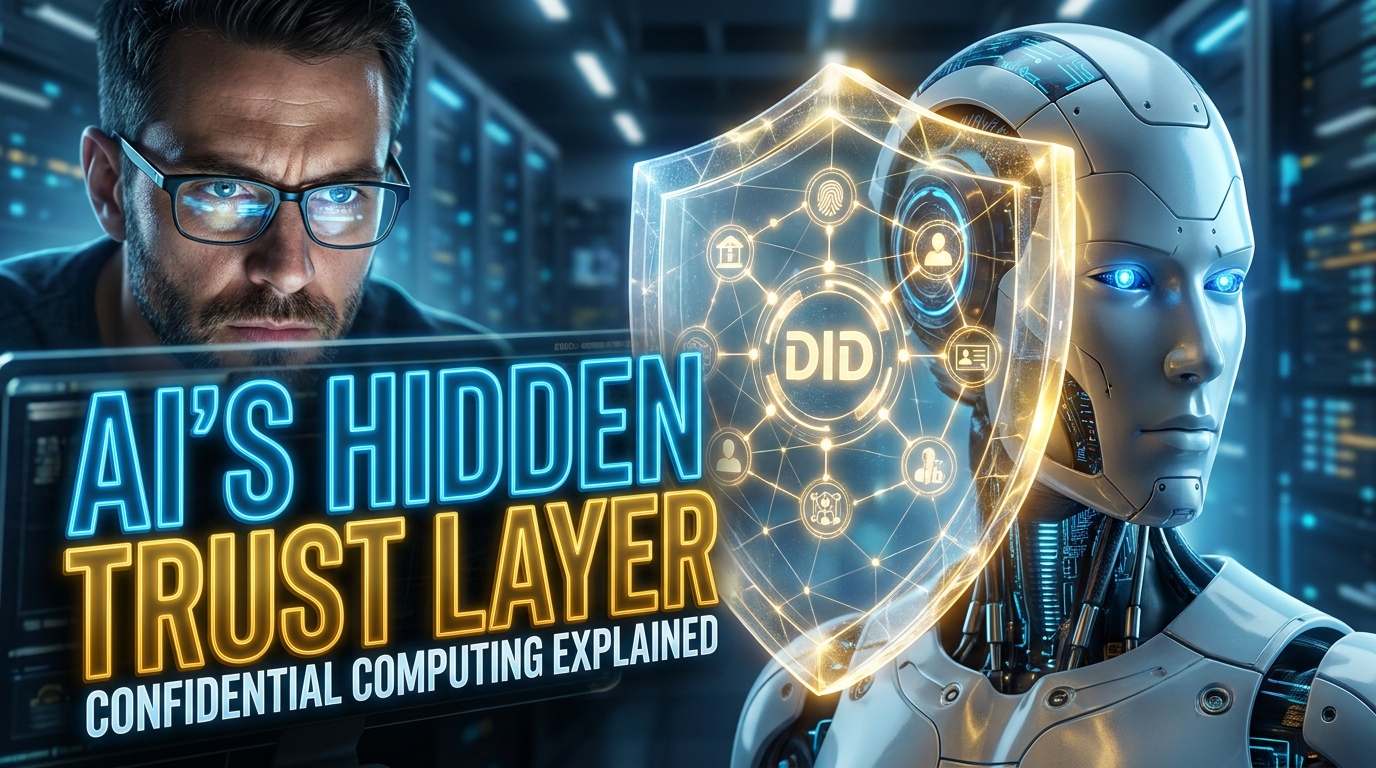
Decentralized Identifiers (DIDs) represent a novel category of globally unique identifiers that are cryptographically verifiable, persistently resolvable, and designed to function without requiring a single, centralized registry or authority. They constitute a core architectural component of the W3C's Decentralized Identifier (DID) specification, a seminal standard engineered to empower individuals, organizations, and indeed, autonomous AI agents, with self-sovereign control over their digital identities.
In stark contrast to traditional identifiers – which are typically tethered to a specific corporate entity, government database, or application-specific repository – DIDs are anchored to decentralized networks. These underlying networks can include public blockchains, permissioned distributed ledgers, or other decentralized peer-to-peer systems. Each DID is intrinsically linked to a corresponding DID Document. This document is a machine-readable data structure that contains essential cryptographic material, primarily public keys, along with service endpoints. These components collectively enable secure, authenticated, and private interactions between disparate entities. This innovative structure serves as the fundamental backbone for Verifiable Credentials (VCs), which are digital proofs or attestations issued by a trusted entity (the Issuer), securely held by another (the Holder, which could be an AI agent), and subsequently presented to a third party (the Verifier) for verification.
Test Agent Primitive
See the concepts from this article in action. No login required.
How DIDs Revolutionize AI Agent Identity and Interaction
- Self-Sovereignty for Agents: With DIDs, AI agents gain the ability to own and independently control their own identities, detached from any single platform, cloud provider, or central authority. This autonomy fosters resilience and reduces reliance on third-party trust.
- Cryptographic Verifiability and Integrity: Every facet of an AI agent's identity, including its associated credentials and interaction history, can be robustly cryptographically signed and verified. This inherent feature virtually eliminates the risks of identity spoofing, tampering, and unauthorized impersonation.
- Granular Control with Verifiable Credentials: Through the intelligent application of Verifiable Credentials (VCs), AI agents can selectively disclose only the most pertinent attributes or proofs of capability required for a specific interaction. For instance, an agent could cryptographically prove it is authorized to access a particular sensitive dataset without needing to reveal its entire operational history, internal logic, or other private information.
- Enhanced Privacy by Design: DIDs are fundamentally designed to support privacy-preserving interactions. By minimizing the amount of data shared and enabling anonymous or pseudonymous attestations, DIDs significantly reduce the attack surface and enhance the overall privacy posture of AI agents and the data they handle.
- Interoperability and Portability: DIDs are built on open, global standards, facilitating seamless interoperability across different platforms, ecosystems, and distributed networks. This ensures that an AI agent's identity and credentials are portable and universally recognized, overcoming vendor lock-in issues prevalent in traditional identity systems.
The Critical Role of Confidential Computing for AI Workloads
While DIDs provide the 'who' and 'what' of trust for AI agents, Confidential Computing (CC) addresses the equally vital 'where' and 'how' of secure execution. Confidential Computing is an industry-wide initiative focused on protecting data in use by performing computation in a hardware-based Trusted Execution Environment (TEE). A TEE is an isolated, cryptographically protected environment within a CPU that ensures the confidentiality and integrity of code and data even from privileged software like hypervisors, operating systems, or cloud administrators.
Key Aspects of Confidential Computing for AI
- Data-in-Use Protection: Traditionally, data is encrypted at rest (in storage) and in transit (over networks). Confidential Computing extends this protection to data while it is actively being processed by the CPU, closing a critical security gap.
- Hardware-Backed Trust: TEEs leverage hardware features (e.g., Intel SGX, AMD SEV, ARM TrustZone) to create enclaves where code and data are isolated and encrypted, providing a strong root of trust that is difficult to compromise.
- Verifiable Attestation: TEEs offer remote attestation, allowing a relying party to cryptographically verify that an application or AI model is running inside a genuine TEE, on trusted hardware, and that the code loaded into the enclave is the expected, untampered version.
- Zero-Trust Environments: In a confidential computing paradigm, even the cloud provider or infrastructure owner cannot access the unencrypted data or the intellectual property of the AI model running within the enclave. This is fundamental for sensitive AI applications.
The Unbreakable Chain: DIDs and Confidential Computing United
The true power emerges when Decentralized Identities are combined with Confidential Computing. This powerful synergy creates an unparalleled trust layer for AI agents, addressing security and privacy challenges end-to-end. Here’s how they integrate:
- Agent Identity and Attestation for Enclave Entry: An AI agent, identified by its unique DID, can present Verifiable Credentials to prove its authenticity and authorization to execute within a specific confidential computing enclave. This ensures that only verified agents with approved capabilities can access the secure environment.
- Secure Code and Data Loading: DIDs can be used to attest to the integrity and origin of the AI model's code and associated data before it is loaded into the TEE. Cryptographic signatures linked to the DID of the model developer or auditor ensure that no malicious alterations have occurred.
- Verifiable Execution within the Enclave: Once inside the TEE, the AI agent's operations are protected from external observation or manipulation. The TEE's remote attestation mechanism can be linked back to the AI agent's DID, providing cryptographically verifiable proof that a particular computation was performed securely by a specific, authorized AI agent within a trusted environment.
- Secure Output and Data Provenance: The results or outputs generated by the AI agent within the confidential enclave can be cryptographically signed by the agent's DID. This creates an auditable trail, ensuring data provenance and non-repudiation for any sensitive insights or actions derived from the protected computation.
- Controlled Access to External Resources: An AI agent operating within a TEE might need to interact with external databases or APIs. Its DID and associated VCs can be used to authenticate these requests, ensuring that the agent's access is strictly controlled and auditable, even from within the secure enclave.
This combined approach ensures that trust is established at multiple layers: the identity of the agent, the integrity of its code, the security of its execution environment, and the provenance of its outputs. It moves AI from a 'black box' of potential risk to a transparent and auditable system of verifiable trust.
Use Cases and Industry Implications
The combination of DIDs and Confidential Computing unlocks a myriad of critical use cases across various industries:
- Financial Services: Securely processing highly sensitive financial transactions, detecting fraud, and performing risk analysis using AI models on encrypted customer data, without exposing that data to the cloud provider.
- Healthcare: AI agents analyzing patient health records for diagnostics or drug discovery within TEEs, where patient identities are managed by DIDs and access is granted via VCs, ensuring HIPAA and GDPR compliance.
- Government and Defense: AI systems processing classified information or engaging in cybersecurity operations, where the integrity of the AI agent and the confidentiality of its data are paramount.
- Supply Chain Management: AI agents verifying product authenticity or optimizing logistics based on sensitive proprietary data, with DIDs tracing each agent's contribution and attesting to data integrity at every step.
- Autonomous Systems (Vehicles, Drones): Ensuring that decision-making AI in autonomous systems is operating with verified code and trusted sensor data, and that its actions are cryptographically signed for auditability and accountability.
This paradigm shift not only enhances security but also enables new business models based on data collaboration, where multiple parties can securely pool and process sensitive data with AI agents without ever fully exposing their raw data to each other or to a central intermediary.
Comparing Identity Approaches for AI Agents
To further illustrate the advantages, let's compare how different identity approaches stack up when applied to AI agents:
| Feature/Criterion | Traditional Centralized Identity (e.g., OAuth, API Keys) | DID-based Identity for AI Agents |
|---|---|---|
| Trust Model | Relies on a single, centralized authority; single point of failure. | Decentralized, cryptographically verifiable trust; no single point of failure. |
| Control & Ownership | Identity owned and managed by the central authority/platform. | Self-sovereign; AI agent owns and controls its own identity. |
| Security Mechanism | API keys, tokens, passwords; susceptible to breaches if central system compromised. | Public-key cryptography, digital signatures; tamper-proof and verifiable. |
| Privacy & Data Minimization | Often requires broad data disclosure for authentication/authorization. | Granular, selective disclosure via Verifiable Credentials (VCs); privacy-preserving. |
| Auditability & Provenance | Auditable within the scope of the central system; limited off-platform. | Cryptographically auditable and verifiable provenance across decentralized networks. |
| Interoperability | Limited to specific platforms or ecosystems; potential vendor lock-in. | Global, open standards-based; high interoperability across systems. |
| Resilience | Vulnerable to central server outages or attacks. | High resilience due to distributed nature of underlying networks. |
Challenges and Future Outlook
While the promise of DIDs and Confidential Computing for AI agents is immense, their widespread adoption comes with certain challenges. These include the need for robust infrastructure development, the standardization of implementation practices, and overcoming the complexity associated with integrating these advanced cryptographic and hardware-backed solutions into existing enterprise architectures. Furthermore, educating developers and organizations on the benefits and nuances of self-sovereign identity and confidential execution remains a critical step.
Despite these hurdles, the trajectory is clear. As AI systems become more sophisticated and impactful, the demand for verifiable trust, ironclad security, and unwavering privacy will only intensify. The combined power of Decentralized Identities and Confidential Computing represents a fundamental shift in how we build, deploy, and trust AI. This integrated approach will not only accelerate the responsible deployment of AI in sensitive domains but will also unlock new possibilities for secure, collaborative, and privacy-preserving AI applications that were previously unimaginable. The future of AI is intrinsically linked to its ability to earn and maintain trust, and DIDs in Confidential Computing are paving the way for that reality.
Ready to Build?
Stop guessing. Start building. Every new account gets 1,000 NOVA credits instantly upon login to test the registry and route intents.
Claim 1,000 Credits →