
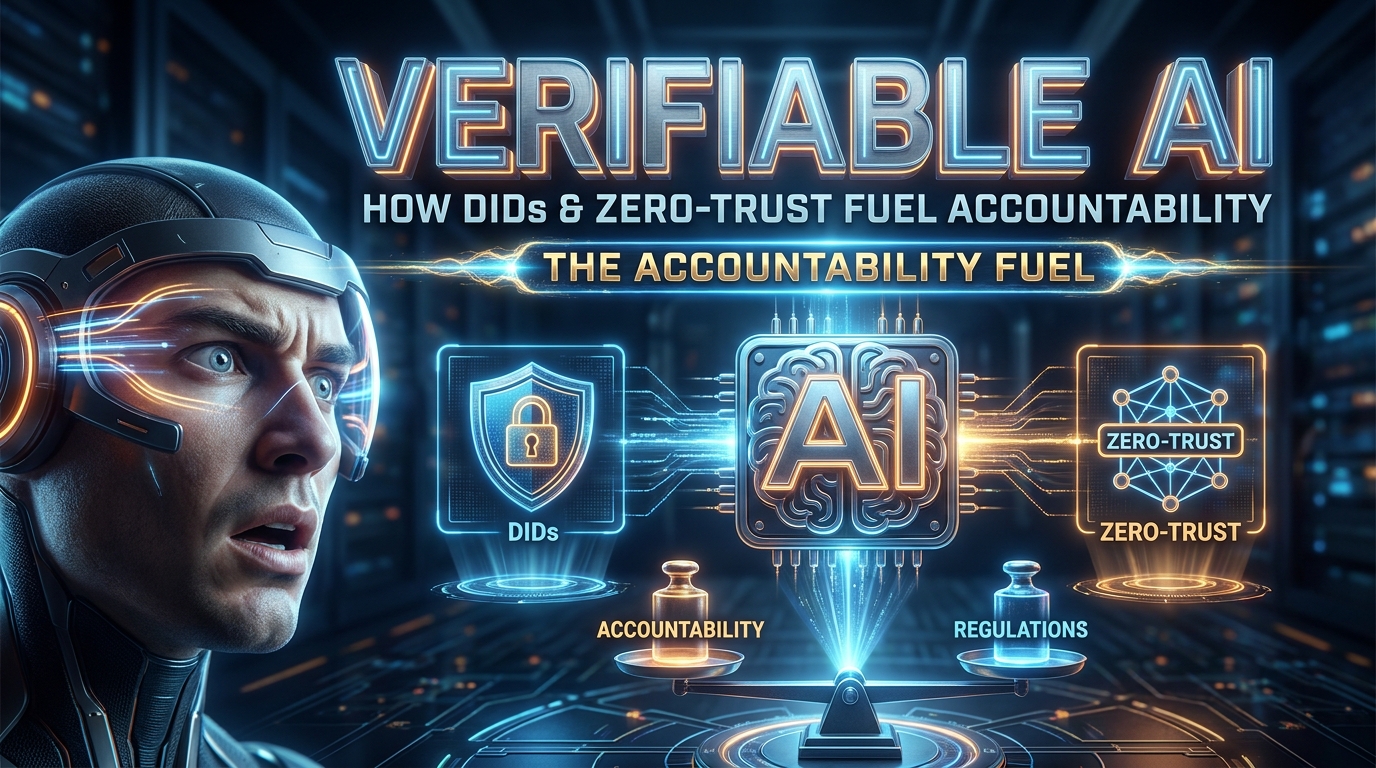
Emerging regulatory frameworks demand unprecedented transparency and accountability from AI systems. From the European Union's pioneering AI Act to NIST's comprehensive AI Risk Management Framework, the global landscape is shifting towards stringent governance for artificial intelligence. Decentralized Identities (DIDs) and Zero-Trust Execution Environments (ZTEEs) fundamentally converge to address this critical need, providing cryptographic attestations of AI agent provenance and tamper-proof guarantees of execution integrity. This synergy offers the verifiable audit trails and secure operational environments essential for demonstrating compliance, fostering trust in autonomous AI agents, and moving beyond theoretical ethics to implementable governance.
As Artificial Intelligence continues its rapid evolution, particularly with the proliferation of autonomous AI agents, the demands for accountability, transparency, and ethical governance are reaching a critical juncture. Pioneering solutions are required to bridge the gap between advanced AI capabilities and the stringent requirements of new regulatory landscapes. At Supernova, we recognize that the future of responsible AI hinges on foundational technologies that can provide verifiable assurance. This article delves into how Decentralized Identities (DIDs) and Zero-Trust Execution Environments (ZTEEs) are not just complementary but fundamentally intertwined in enabling this crucial verifiable accountability for AI agents.
The Imperative: Why Verifiable AI Matters for Emerging Regulations
The acceleration of AI deployment across every sector – from healthcare diagnostics to financial trading and critical infrastructure management – has outpaced the development of corresponding governance frameworks. Regulators worldwide are now scrambling to catch up, introducing landmark legislation designed to mitigate risks, protect fundamental rights, and ensure societal well-being. These regulations, such as the EU AI Act, are not merely guidelines; they are legally binding mandates that require demonstrable proof of an AI system's trustworthiness, safety, and ethical alignment.
Without verifiable mechanisms, organizations face substantial compliance risks, including hefty fines, reputational damage, and operational disruptions. The need for verifiable AI is no longer a theoretical debate but a practical necessity for market access and public trust. It demands technologies that can provide undeniable evidence of an AI agent's attributes and behavior throughout its entire lifecycle.
Unpacking the Accountability Challenge in AI Agents
The rise of sophisticated AI agents, from hyper-personalized chatbots to autonomous decision-making systems in critical infrastructure, presents an unprecedented challenge for accountability. Traditional software auditing and governance mechanisms often fall short due to several inherent characteristics of AI:
Opacity (The Black Box Problem)
Many advanced AI models, particularly deep learning networks, operate as 'black boxes,' making their internal decision-making processes incredibly difficult to interpret or explain. This lack of transparency directly clashes with regulatory demands for explainability. When an AI makes a critical decision, understanding the 'why' is paramount for trust, debugging, and legal recourse. Without verifiable insights into its reasoning, proving compliance with non-discrimination laws or safety standards becomes nearly impossible.
Distributed and Dynamic Nature
AI agents often interact with numerous data sources, other agents, and external services, creating complex, distributed ecosystems. Their operational boundaries are fluid, and their behaviors can evolve through continuous learning, making fixed-point auditing insufficient. This dynamic nature means that an AI's state and behavior are constantly changing, making it challenging to establish a consistent baseline for accountability or to pinpoint when and why a behavior changed.
Lack of Clear Attribution and Responsibility
When an AI agent makes an error or causes harm, tracing the root cause back to a specific model version, training data set, developer, or even a particular line of code can be incredibly complex. Who is responsible? Is it the data scientist, the model architect, the data provider, or the deployer? This diffusion of responsibility complicates legal and ethical accountability frameworks, demanding precise attribution for every component and action within the AI's lifecycle.
Data Provenance and Integrity
The quality and integrity of training data profoundly impact an AI model's behavior, often introducing biases or vulnerabilities. Verifying the source, cleanliness, ethical acquisition, and unbiased nature of data throughout an AI agent's lifecycle is a significant hurdle. Regulators are increasingly focusing on data governance, requiring proof that data used for AI development is lawful, accurate, and free from harmful biases.
Test Agent Primitive
See the concepts from this article in action. No login required.
Addressing Bias, Fairness, and Ethical Deployment
Beyond technical challenges, AI agents pose significant ethical dilemmas regarding bias, fairness, and discrimination. Ensuring an AI system treats all individuals and groups equitably requires continuous monitoring, evaluation, and verifiable proof of adherence to ethical guidelines. Regulations mandate impact assessments and mitigation strategies for potential biases, requiring transparent reporting and demonstrable action.
Environmental and Resource Impact
The training and operation of large AI models consume vast amounts of energy and resources, contributing to environmental concerns. While not always at the forefront of initial regulations, the environmental footprint of AI is an emerging area of accountability. Verifiable reporting on energy consumption and sustainable practices may become increasingly important for responsible AI deployment.
The 'Black Box' Problem and Regulatory Pressure
Regulators worldwide are increasingly demanding transparency and explainability from AI systems. The 'black box' nature of many AI models clashes directly with these demands. Without verifiable mechanisms to prove what an AI agent is, how it was trained, and how it executes, organizations face significant compliance risks. This pressure drives the need for technologies like DIDs and ZTEEs that can effectively 'open up' or attest to the internals of these systems without necessarily revealing proprietary IP.
Decentralized Identities (DIDs): The Foundation of AI Provenance
Decentralized Identities (DIDs) represent a paradigm shift in how digital identities are managed and verified. Unlike traditional centralized identity systems that rely on a single authority (like a company database or government registry), DIDs are self-sovereign. This means individuals, organizations, or even inanimate objects and AI agents can own and control their digital identifiers, linking them to cryptographically verifiable claims or credentials without relying on a central point of control. For AI, DIDs provide a persistent, globally unique, and resolvable identifier that isn't beholden to a specific platform or vendor.
The Power of Verifiable Credentials (VCs) for AI Traceability
The power of DIDs is significantly amplified by Verifiable Credentials (VCs). VCs are tamper-proof digital attestations issued by trusted parties, cryptographically signed, and linked to a DID. They function much like a digital passport, degree, or license, but with enhanced privacy and security features. For AI agents, VCs can establish a robust, verifiable audit trail across its entire lifecycle:
- Agent Identity & Registration: An AI agent can be issued a DID, acting as its unique digital identifier. VCs can then attest to its creation date, developer, legal owner, intended purpose, and any specific certifications (e.g., 'certified for medical diagnostic use' or 'trained on GDPR-compliant data'). This creates a foundational, immutable record of the AI's existence and purpose.
- Model Provenance & Versioning: VCs can document the origin and evolution of an AI model. This includes cryptographically linking specific model versions, detailing the training data sets used (with references to their DIDs), outlining the training methodology, and recording validation metrics. This creates a digital 'birth certificate' and a continuous 'medical record' for the model, showing its lineage and development history.
- Data Source Attestation & Quality: Verifiable Credentials can confirm the provenance and integrity of the data used for training and operation. For instance, a VC could attest that a specific dataset originates from a verified source, has been pre-processed according to specific standards, or has undergone privacy-preserving transformations. This is crucial for complying with data governance and privacy regulations.
- Compliance & Certification Status: As AI regulations evolve, agents may require various certifications or licenses to operate in specific domains. VCs can serve as digital proof of compliance, issued by regulatory bodies or independent auditors, attesting that an AI agent meets specific safety, ethical, or performance standards (e.g., 'EU AI Act High-Risk Compliant').
- Ethical Alignment & Impact Assessments: VCs can attest to the completion of ethical AI assessments, bias audits, or adherence to specific fairness principles. This provides verifiable evidence of an organization's commitment to responsible AI development and deployment.
- Operational Audit Trails: DIDs can be used by AI agents to sign their actions or decisions, creating an immutable log linked to their unique identity. This allows for clear attribution and an indisputable audit trail of an AI's operational history, vital for post-incident analysis and accountability.
Zero-Trust Execution Environments (ZTEEs): Guaranteeing AI Integrity
While DIDs provide the 'what' and 'who' of AI provenance, Zero-Trust Execution Environments (ZTEEs) address the 'how' and 'where' of AI execution. ZTEEs are secure, isolated processing environments, often backed by hardware (like Intel SGX, AMD SEV, or ARM TrustZone), designed to protect code and data in use from unauthorized access or modification, even from privileged software on the same system. They are a critical component of 'confidential computing,' ensuring that an AI model runs exactly as intended, without external interference.
The Zero-Trust Paradigm in AI Execution
The core principle of Zero-Trust is 'never trust, always verify.' In the context of AI, this means that even if an AI model or data resides on a supposedly secure server, its execution and processing environment must be continuously verified as untampered. ZTEEs extend this paradigm by creating cryptographically protected enclaves where AI algorithms can operate on sensitive data with absolute certainty that both the code and the data remain confidential and integral throughout the computation process.
Key Benefits of ZTEEs for AI Accountability
- Tamper-Proof Execution: ZTEEs provide strong cryptographic assurances that the AI model's code has not been altered and is executing exactly as intended. This is crucial for high-stakes applications where the integrity of AI decisions is paramount, preventing malicious injection or accidental corruption.
- Data Confidentiality & Privacy: Sensitive training data, proprietary model weights, or confidential input data can be processed within a ZTEE, remaining encrypted and inaccessible to the host operating system, hypervisor, or even cloud providers. This significantly enhances privacy compliance, especially for data subject to GDPR, CCPA, or similar regulations.
- Hardware-Backed Attestation: ZTEEs allow for remote attestation, where a third party can cryptographically verify that the AI model is running inside a legitimate and secure enclave with the correct software configuration. This provides irrefutable proof of a trusted execution environment.
- Reproducible and Auditable Operations: By ensuring a consistent and secure execution environment, ZTEEs contribute to the reproducibility of AI outcomes. Combined with DID-attested model versions, this makes AI operations more auditable and predictable, a key requirement for regulatory oversight.
The Synergistic Power: DIDs & ZTEEs for End-to-End Verifiable AI
The true power for achieving comprehensive AI accountability emerges when Decentralized Identities and Zero-Trust Execution Environments are integrated. DIDs, with their associated Verifiable Credentials, build a verifiable identity and provenance chain for every aspect of an AI's existence – its creators, its data, its versions, and its certifications. ZTEEs, on the other hand, guarantee the integrity and confidentiality of the AI's runtime, ensuring that the verified model executes securely and accurately.
A Unified Framework for AI Accountability
Imagine an autonomous AI agent in a high-risk application, such as medical diagnostics. Its DID would attest to its developer, the specific version of its diagnostic model, the clinical data it was trained on (certified for anonymization and ethical use via VCs), and its regulatory approval. When this AI processes a patient's sensitive medical data, it would do so within a ZTEE. This ZTEE would cryptographically attest that the approved model version is running, unaltered, and that the patient data remains confidential during processing. Any diagnostic output generated would then be cryptographically signed by the AI's DID, linking the decision directly to its verified identity and secure execution environment. This creates an unbroken chain of verifiable trust.
Addressing Regulatory Demands with DIDs and ZTEEs
The combined architecture of DIDs and ZTEEs directly addresses the multifaceted requirements of emerging AI regulations. It shifts accountability from a post-incident investigation based on assumptions to a proactive, verifiable assurance model.
| Regulatory Requirement | How DIDs Contribute | How ZTEEs Contribute |
|---|---|---|
| Transparency & Explainability | Attest to model provenance, training data, development lifecycle, and ethical assessments via VCs. Enable verifiable information provision to users. | Ensure verifiable, un-tampered execution logic; protect proprietary algorithms during verification; guarantee the integrity of explanation generation modules. |
| Accountability & Attribution | Link AI actions and decisions to verifiable identities (agent, developer, data owner, auditor) through cryptographically signed VCs. | Provide tamper-proof audit trails of execution; ensure actions originate from authorized and unmodified code, enabling indisputable attribution of runtime behavior. |
| Data Governance & Privacy | Attest to data origin, usage rights, ethical acquisition, and compliance with privacy regulations (e.g., GDPR, CCPA). | Process sensitive data in isolated, confidential enclaves; prevent unauthorized access or leakage during computation; ensure compliance with data minimization principles. |
| Robustness & Safety | Attest to comprehensive testing, validation, and safety certifications; verify adherence to safety standards throughout the development pipeline. | Prevent malicious tampering, unauthorized modification, or exploitation of AI models in production; ensure consistent, predictable, and secure execution resistant to external attacks. |
| Bias & Fairness | Attest to fairness audits, debiasing techniques, and ethical guidelines applied during development; provide verifiable proof of responsible AI practices. | Ensure that fairness-enhancing algorithms, debiasing models, and data preprocessing steps run as intended without interference, thereby preserving the integrity of bias mitigation efforts. |
Navigating the Regulatory Landscape: DIDs and ZTEEs in Action
The European Union AI Act: A Blueprint for Responsible AI
The EU AI Act categorizes AI systems based on their risk level, imposing stricter requirements on 'high-risk' AI. DIDs and ZTEEs are instrumental in meeting these elevated demands:
- Article 10 (Data Governance): DIDs and VCs allow for verifiable attestation of training, validation, and testing data quality, origin, and adherence to privacy principles, directly addressing the need for robust data governance.
- Article 13 (Transparency and provision of information to users): DIDs enable transparent identification of AI system providers and deployers, while VCs can provide verifiable information about the AI's purpose, capabilities, and limitations. ZTEEs ensure that the provided information accurately reflects the actual execution.
- Article 14 (Human Oversight): The ability to verifiably attribute an AI's actions to its identity and secure execution environment provides the necessary audit trails for human oversight mechanisms to effectively monitor and intervene when required.
- Article 15 (Robustness, Accuracy and Security): ZTEEs provide the hardware-backed guarantees for robustness and security by preventing tampering and ensuring accurate execution, while DIDs can attest to the testing and validation processes that confirm accuracy.
NIST AI Risk Management Framework (RMF)
The NIST AI RMF provides a flexible framework for managing AI risks. DIDs and ZTEEs align perfectly with its core functions:
- Govern: DIDs establish clear ownership and accountability, supporting organizational governance structures for AI.
- Map: VCs can map the entire lifecycle of an AI, identifying risks and their mitigation strategies.
- Measure: ZTEEs ensure that measurement tools and evaluations run in a trusted environment, providing reliable metrics.
- Manage: The verifiable audit trails provided by the combined solution enable effective risk management and incident response.
Broader Implications for Data Privacy (GDPR, CCPA)
Beyond AI-specific regulations, DIDs and ZTEEs bolster compliance with general data protection regulations like GDPR and CCPA. ZTEEs allow sensitive personal data to be processed by AI models without ever being exposed to the cloud provider or other unauthorized entities, significantly reducing data breach risks and enhancing data subject rights. DIDs, through VCs, can attest to consent mechanisms, data usage policies, and anonymization techniques, providing verifiable proof of privacy-preserving practices.
Challenges and the Path Forward
While the promise of DIDs and ZTEEs for verifiable AI is immense, their widespread adoption comes with challenges. These include the technical complexity of implementation, ensuring interoperability across different ZTEE vendors and DID methods, managing performance overhead, and establishing industry-wide standardization. Education and collaboration across AI developers, regulators, and infrastructure providers will be crucial.
Innovators like Supernova are at the forefront, developing platforms that abstract away much of this complexity, making DIDs and ZTEEs accessible for real-world AI deployments. By providing tools and services that integrate these foundational technologies, they are paving the way for a new era of accountable and trustworthy AI.
Conclusion: The Future of Accountable AI
The convergence of Decentralized Identities and Zero-Trust Execution Environments represents a paradigm shift in how we build, deploy, and govern AI systems. By providing cryptographic assurances of provenance and execution integrity, these technologies offer a robust, verifiable framework for accountability that is indispensable in the face of emerging regulations. They are not merely enhancements; they are fundamental pillars for establishing trust, ensuring compliance, and enabling the responsible innovation of autonomous AI agents. Organizations that embrace this synergy will not only meet regulatory mandates but will also cultivate a competitive advantage built on undeniable trust and ethical leadership in the rapidly evolving AI landscape.
Ready to Build?
Stop guessing. Start building. Every new account gets 1,000 NOVA credits instantly upon login to test the registry and route intents.
Claim 1,000 Credits →