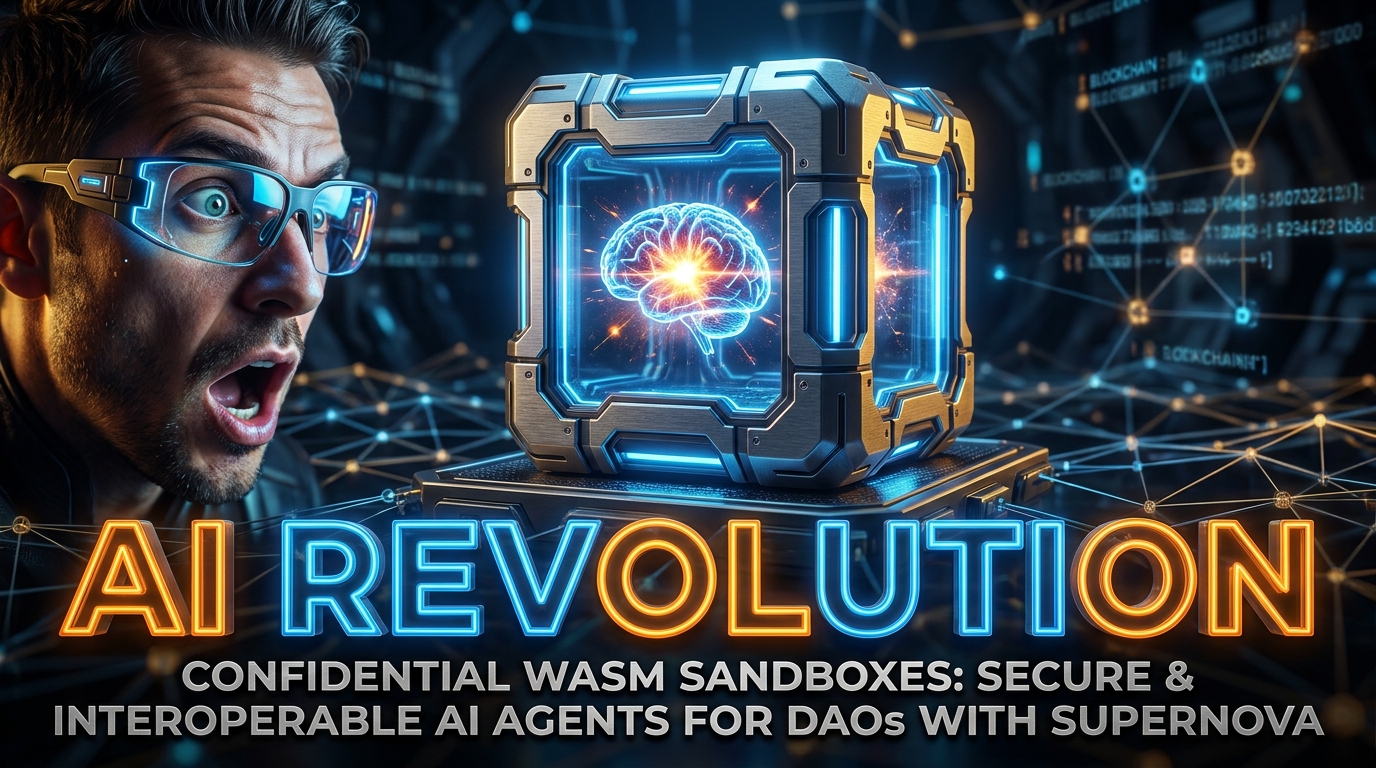
Confidential WebAssembly (Wasm) sandboxes represent a pivotal advancement for Decentralized Autonomous Organizations (DAOs), offering a robust solution to the inherent security and interoperability challenges of integrating AI agents. Supernova champions this innovation, providing the infrastructure for AI developers and enterprise teams to deploy agents that protect sensitive data, maintain model integrity, and function seamlessly across diverse blockchain environments, fostering unprecedented trust and efficiency in decentralized governance.
The Imperative for Secure AI in Decentralized Autonomous Organizations
Decentralized Autonomous Organizations (DAOs) stand at the forefront of a new paradigm for collective governance and value creation. Operating on the principles of transparency, immutability, and community-driven consensus, DAOs leverage blockchain technology to manage assets, execute decisions, and coordinate efforts without relying on traditional centralized intermediaries. The integration of Artificial Intelligence (AI) agents into DAO operations is not merely an enhancement; it is a critical step towards unlocking their full potential. From automating complex treasury management strategies to refining governance proposals, facilitating advanced analytics, and even orchestrating sophisticated DeFi operations, AI agents promise to imbue DAOs with unparalleled intelligence, efficiency, and responsiveness.
However, this powerful synergy between AI and DAOs introduces a profound and critical dilemma: how can DAOs harness AI's transformative capabilities without compromising their foundational tenets of security, privacy, and decentralization? The core conflict arises because traditional AI deployments are fundamentally centralized. They typically rely on proprietary cloud infrastructure, where sensitive data and intellectual property (AI models) are processed in environments controlled by third parties. This exposes crucial data to privacy risks, makes AI models vulnerable to tampering or intellectual property theft, and creates single points of failure—all anathema to the distributed, trustless ethos of DAOs.
For a DAO, where trust is distributed across its members and consensus is paramount for operational integrity, these vulnerabilities are not merely inconveniences; they are existential threats. Outsourcing AI computation or data processing to an untrusted or even partially trusted environment can severely undermine the DAO's integrity. Such exposures could lead to catastrophic data leaks, biased decision-making influenced by external factors, or even malicious control of the DAO's autonomous functions, eroding the very trust layer upon which DAOs are built.
What Fundamental Security Challenges Do AI Agents Introduce to DAOs?
The integration of AI agents into a decentralized ecosystem brings forth a unique and complex set of security, privacy, and trust challenges that demand rigorous and innovative solutions. Addressing these challenges is not optional; it is fundamental to the successful and secure evolution of decentralized intelligence:
- Data Confidentiality: AI models, whether for training or inference, frequently require access to highly sensitive, private, or proprietary data. Within a DAO context, this could encompass confidential member voting patterns, sophisticated financial strategies, proprietary market analytics, or even personal data of participants. Exposing this invaluable data to untrusted computational environments or third-party cloud providers risks severe privacy breaches, competitive disadvantages, and potential regulatory non-compliance. Ensuring that data remains private and protected throughout its lifecycle, especially during active computation, is paramount.
- Model Integrity and Verifiability: An AI model is a critical intellectual asset. For a DAO, ensuring that the executed model is precisely the intended, audited, and approved version—without any clandestine modifications or substitutions—is non-negotiable. The integrity of the model itself can be compromised through various means, including model poisoning during training or stealthy alterations post-deployment. Furthermore, the outputs generated by an AI agent, particularly when influencing critical DAO governance decisions, asset management, or smart contract interactions, must be verifiable, auditable, and attributable to the specific, untampered model and data inputs.
- Execution Integrity: Beyond the integrity of the AI model, the environment in which the AI agent's computations are performed must be absolutely secure and trustworthy. How can a DAO be definitively certain that an AI's complex calculations are executed correctly, without any manipulation, unauthorized data access via side-channel attacks, or information leakage during runtime? This challenge is amplified in a distributed system where various nodes, potentially operated by diverse and untrusted entities, contribute to the computational network. The computations must be provably free from interference.
- Byzantine Fault Tolerance for AI: DAOs are architected to withstand Byzantine faults, meaning they can continue to operate correctly even if some participants act maliciously or fail unexpectedly. AI agents integrated into DAOs must inherit and extend this resilience. The question arises: how can a DAO ensure that a rogue AI agent, or an agent whose underlying computational environment has been compromised, cannot unilaterally inflict harm upon the organization, compromise its assets, or subvert its governance processes? Robust mechanisms are needed to isolate and contain potential threats.
- Interoperability Across Diverse Chains and Data Sources: Modern DAOs rarely operate in isolation. They often span multiple blockchain environments (e.g., Ethereum, Polygon, Solana), interact with various Layer 2 solutions, and integrate with a multitude of off-chain data sources. AI agents must possess the ability to function seamlessly and securely within this heterogeneous landscape, without being constrained by a single chain's execution model or security primitives. Achieving secure and trustless cross-chain computation and data exchange for AI is a significant hurdle.
- Adversarial Attacks and AI Robustness: AI models, particularly deep learning networks, are notoriously susceptible to adversarial attacks. These involve subtle, often imperceptible, perturbations to input data that can cause an AI model to make grossly erroneous or maliciously intended outputs. Protecting AI agents from such sophisticated attacks requires not only robust model design but also secure and isolated execution environments that can detect or mitigate such manipulations, ensuring the AI's reliability in critical DAO functions.
- Regulatory Compliance and Accountability: As AI systems become more prevalent and impactful, regulatory frameworks (like the EU AI Act) are emerging globally. DAOs leveraging AI agents, especially for high-stakes decisions, will eventually face questions of compliance, transparency, and accountability. How can a decentralized entity demonstrate that its AI adheres to ethical guidelines, data privacy laws, and safety standards, particularly when the AI's operations might be opaque or distributed?
Enter Confidential Computing: A Paradigm Shift for AI Security in Decentralized Ecosystems
Confidential computing emerges as a transformative and indispensable solution to these pressing security challenges, particularly for sensitive AI workloads within DAOs. It represents a groundbreaking evolution in cloud computing security, focusing on isolating and protecting sensitive data and code not just when it's at rest (encrypted storage) or in transit (encrypted communication), but critically, also while it is in use during computation. This is achieved by executing workloads within hardware-protected environments known as Trusted Execution Environments (TEEs).
A TEE is a secure, isolated area within a CPU that guarantees the confidentiality and integrity of the code and data loaded inside it. Even the operating system, hypervisor, or the underlying cloud provider's administrators cannot access or tamper with the data or computations occurring within a TEE. This innovative approach provides an unprecedented level of security: data remains encrypted throughout its entire lifecycle, making it completely inaccessible to unauthorized entities, including the underlying infrastructure provider, other applications running on the same server, or even malicious insiders with privileged access to the physical hardware.
Test Agent Primitive
See the concepts from this article in action. No login required.
Major silicon vendors such as Intel (with SGX - Software Guard Extensions and TDX - Trust Domain Extensions), AMD (with SEV - Secure Encrypted Virtualization), and ARM (with TrustZone) have developed and implemented TEE technologies. These hardware-level fortifications are the cornerstone of confidential computing, establishing a hardware root of trust that can cryptographically attest to the integrity of the execution environment and the code running within it. This attestation mechanism allows remote parties (like a DAO) to cryptographically verify that their AI agent is running on legitimate, untampered hardware and executing the intended code, providing a verifiable proof of execution that is crucial for trustless systems.
WebAssembly (Wasm): The Universal Language for Secure & Interoperable AI Agents
While Confidential Computing provides the robust hardware-level security, WebAssembly (Wasm) provides the ideal software-level execution environment for AI agents within these TEEs. Wasm is a low-level bytecode format designed for efficient execution and compact representation, making it uniquely suited for high-performance, sandboxed applications.
The synergy between Confidential Computing and Wasm is profound: Wasm offers a portable, efficient, and inherently secure software sandbox, while Confidential Computing provides the hardware-secured, confidential execution environment. This layered approach creates an exceptionally robust and versatile platform for AI agents, particularly for the demanding requirements of DAOs.
Key advantages of Wasm in this context include:
- Universal Portability: Wasm's design allows it to run nearly anywhere—web browsers, servers, edge devices, and crucially, within TEEs—independent of the underlying operating system or hardware architecture. This universality is vital for DAOs that need AI agents to operate across diverse blockchain nodes and environments without modification.
- Near-Native Performance: Wasm executes at speeds comparable to native code, making it suitable for computationally intensive AI tasks like model inference, which often require significant processing power.
- Strong Security Sandbox: By design, Wasm modules run in a strict sandbox, isolated from the host environment. They have no direct access to system resources unless explicitly granted, mitigating many common security vulnerabilities. This software-level isolation perfectly complements the hardware-level isolation of TEEs.
- Determinism: Wasm's specification aims for deterministic execution, meaning that given the same inputs, a Wasm module will produce the exact same outputs consistently. This property is invaluable for blockchain applications and DAOs, where verifiable and reproducible computations are essential for consensus and auditability.
- Compact Footprint: Wasm binaries are typically small, leading to faster loading times and reduced resource consumption, which is beneficial for deployment in resource-constrained environments or for quick, on-demand AI tasks.
Supernova's Solution: Orchestrating Confidential Wasm Sandboxes for DAO AI
Supernova stands at the forefront of this innovation, providing the critical infrastructure and developer tools that enable DAOs to leverage the power of Confidential Wasm sandboxes for their AI agents. Supernova's platform is meticulously engineered to bridge the gap between advanced AI capabilities and the stringent security and interoperability demands of decentralized governance.
Supernova abstracts away the complexities of confidential computing and Wasm deployment, offering a streamlined experience for AI developers and enterprise teams. Our solution allows for the creation, deployment, and management of AI agents that are:
- Inherently Confidential: AI models and the sensitive data they process are protected within hardware-secured TEEs, ensuring privacy from the underlying infrastructure, malicious actors, and even the DAO's own node operators.
- Tamper-Proof and Verifiable: The integrity of the AI model and its execution environment is cryptographically attested. This means DAOs can verify that the AI agent is running the correct, uncompromised model and that its outputs are the result of legitimate computations.
- Interoperable by Design: Leveraging Wasm's universal runtime, Supernova facilitates the seamless deployment and interaction of AI agents across various blockchain networks and off-chain data sources, fostering a truly composable and interconnected decentralized ecosystem.
- Scalable and Efficient: The combination of Wasm's performance and the efficiency of confidential computing infrastructure allows DAOs to scale their AI operations without sacrificing security or responsiveness.
Key Benefits of Supernova's Confidential Wasm Sandboxes for DAOs
The strategic deployment of AI agents through Supernova's platform provides DAOs with a suite of unparalleled advantages, fundamentally transforming how decentralized organizations can operate and evolve:
| Feature Area | Traditional AI in Centralized Cloud | AI in DAO (without CC/Wasm) | AI in DAO (with Supernova & Confidential Wasm) |
|---|---|---|---|
| Data Confidentiality During Use | Low (provider access, insider threat) | Low (exposure on untrusted nodes) | High (hardware-enforced TEE) |
| Model Integrity & Tamper-Proofing | Moderate (software-level protection) | Low (vulnerable to node operator, attack) | High (cryptographic attestation) |
| Execution Verifiability | Low (opaque computation) | Low (difficult to prove correct execution) | High (remote attestation & Wasm determinism) |
| Interoperability Across Chains | Limited (vendor lock-in, proprietary APIs) | Challenging (security & compatibility issues) | High (Wasm's universal runtime & Supernova's platform) |
| Resistance to Adversarial Attacks | Software-dependent mitigation | Vulnerable due to environment exposure | Enhanced (isolated execution reduces attack surface) |
| Trust Model | Centralized (trust in cloud provider) | Distributed but vulnerable (trust in node operators) | Trustless (hardware-enforced guarantees) |
This table illustrates how Supernova's solution specifically addresses and overcomes the limitations of traditional and even nascent AI integrations within DAOs, establishing a new standard for trust and efficiency.
Transformative Use Cases for AI Agents in DAOs with Supernova
The application of secure, interoperable AI agents powered by Supernova opens up a vast array of transformative use cases for DAOs, enabling them to operate with unprecedented autonomy, intelligence, and reliability:
- Automated Treasury Management: AI agents can confidentially analyze market data, predict trends, identify optimal yield farming strategies, and execute rebalancing operations for DAO treasuries. All decisions and transactions can be processed within TEEs, protecting sensitive financial strategies from competitors or front-running, while ensuring integrity of execution.
- Enhanced Governance and Proposal Analysis: AI can analyze complex governance proposals, summarize their implications, detect potential conflicts of interest, and even gauge community sentiment from vast datasets. By running within confidential sandboxes, these AI agents can process private voting patterns or member activity data without exposing individual identities, providing truly unbiased and data-driven insights to DAO members.
- Decentralized Finance (DeFi) Optimization: AI agents can operate across various DeFi protocols, executing sophisticated arbitrage strategies, managing liquidity pools, or optimizing lending and borrowing positions. The confidentiality ensures that these profitable strategies remain proprietary, and the execution integrity prevents manipulation by external actors.
- Dynamic Content Curation and Moderation for Media DAOs: In DAOs focused on media, content creation, or NFTs, AI can assist in curating relevant content, identifying trending assets, or even moderating community interactions. Confidential Wasm ensures that sensitive user data or proprietary algorithms for content recommendation are protected.
- Fraud Detection and Risk Management: AI agents can monitor transaction patterns across a DAO's ecosystem for anomalies indicative of fraud or security breaches. Running these agents in TEEs allows them to access and process sensitive transaction histories and user behavioral data for effective threat detection without compromising privacy.
- Decentralized Identity and Reputation Systems: AI can help evaluate and manage decentralized identity and reputation scores for DAO members, based on various on-chain and off-chain activities. Confidential computing ensures that the sensitive data used for these evaluations remains private, preventing discrimination or unfair profiling.
The Future Landscape: Trust, Autonomy, and Scalability for Decentralized Intelligence
The advent of Confidential Wasm sandboxes, meticulously orchestrated by Supernova, marks a critical inflection point for the evolution of DAOs. This technology not only resolves the inherent conflict between AI's power and DAO's principles but also propels decentralized organizations into an era of unprecedented capability.
By guaranteeing the confidentiality of data and models, the integrity of execution, and the verifiability of outcomes, Supernova empowers DAOs to integrate AI agents that are truly autonomous, trustworthy, and scalable. This foundation of secure intelligence will enable DAOs to:
- Build Trustless Automation: Automate complex, high-value operations with full confidence in the AI's integrity and privacy.
- Unlock New Levels of Interoperability: Seamlessly extend AI intelligence across the fragmented blockchain landscape, connecting disparate ecosystems.
- Accelerate Innovation: Foster a secure environment for AI developers to build and deploy groundbreaking decentralized applications without compromising on core values.
- Enhance Resilience: Equip DAOs with sophisticated, self-protecting AI capabilities that bolster their security posture against emerging threats.
Supernova is not just offering a technological solution; it is enabling a philosophical shift. It allows DAOs to embrace the full spectrum of AI's potential, moving beyond simple automation to genuine decentralized intelligence, where collective decision-making is augmented by secure, private, and verifiable AI. This future promises DAOs that are more efficient, more intelligent, and fundamentally more resilient, laying the groundwork for the next generation of decentralized innovation.
In conclusion, the journey towards fully realized, intelligent DAOs demands a robust security and interoperability layer for AI agents. Confidential Wasm sandboxes, powered by Supernova, provide precisely this, ushering in an era where AI can truly thrive within decentralized ecosystems, fostering unprecedented trust, efficiency, and progress.
Ready to Build?
Stop guessing. Start building. Every new account gets 1,000 NOVA credits instantly upon login to test the registry and route intents.
Claim 1,000 Credits →