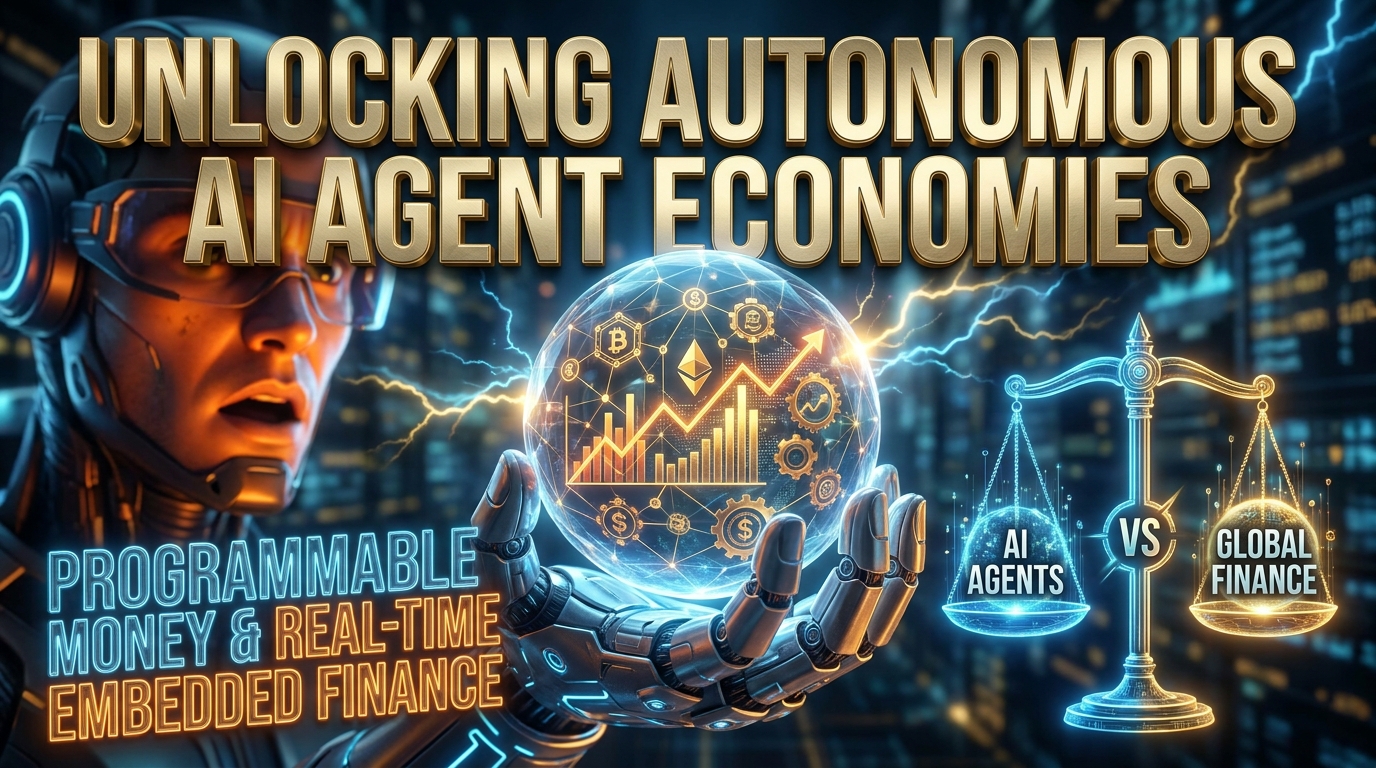
The convergence of programmable money frameworks and real-time embedded finance is not merely an evolutionary step in financial technology; it represents a fundamental paradigm shift that is poised to unlock the full potential of autonomous AI agent economies. This powerful synergy empowers artificial intelligence agents to operate with unprecedented financial autonomy, enabling them to execute self-sovereign transactions, access diverse services, and generate revenue dynamically and efficiently, all without direct human intervention. This foundational shift is propelling us towards a future of highly efficient, scalable, and entirely new AI-native business models, laying the groundwork for the next generation of automated digital commerce and sophisticated service delivery.
As AI systems become increasingly sophisticated and integrated into every facet of our digital and physical world, their ability to interact financially, autonomously and in real-time, becomes a critical bottleneck if traditional financial rails are maintained. The promise of intelligent agents that can manage their own resources, pay for services, and even earn income requires a financial infrastructure that is as intelligent, dynamic, and automated as the agents themselves. Programmable money and real-time embedded finance are precisely these enabling technologies, transforming AI from a computational tool into an economic participant.
Understanding Programmable Money Frameworks
Programmable money represents a revolutionary leap in the concept of financial transactions, transcending the limitations of static, human-mediated exchanges to embrace dynamic, code-driven transfers. At its very essence, programmable money embeds transactional logic directly into the currency or payment mechanism itself. This groundbreaking capability dictates that funds can only be spent, moved, or accessed when specific, pre-defined conditions are rigorously met. This intelligent automation is predominantly powered by cutting-edge advancements in blockchain technology, most notably through the implementation of smart contracts. These smart contracts function as self-executing agreements, where the terms and conditions are immutably written directly into lines of code, ensuring transparency and tamper-proof execution.
Unlike conventional digital payment systems, which fundamentally serve as digitized versions of existing fiat currencies, programmable money introduces an entirely new and sophisticated layer of intelligent automation and granular control over monetary flows. This isn't just about faster transactions; it's about smarter money that understands context and conditions, acting as a programmable interface to economic value.
- Conditionality: Funds are intrinsically linked to predefined conditions, allowing for release or locking based on specific events, verified data feeds from oracles, or time-based triggers. This enables sophisticated escrow services, automated royalty payments, and even conditional access to resources.
- Automated Execution: Transactions are initiated and completed automatically, without any need for manual intervention, once all stipulated conditions are unequivocally met. This removes human error and latency from critical financial operations.
- Transparency & Immutability: Leveraging distributed ledger technology (DLT), programmable money provides an auditable, transparent, and tamper-proof record of every transaction. This enhances trust and reduces disputes, which is crucial for autonomous systems.
- Tokenization: A broad spectrum of assets – including fiat currencies (as stablecoins), securities, commodities, and even intellectual property rights – can be digitally represented as tokens. This tokenization facilitates granular control, fractional ownership, and seamless, programmatic transferability across various platforms.
- Composability: Programmable money frameworks are inherently designed to be composable. They can be seamlessly integrated and combined with other digital protocols, decentralized applications (dApps), and services, fostering the creation of incredibly complex and sophisticated financial ecosystems. This modularity allows for innovation and layering of services.
The evolution of money, from rudimentary bartering systems to physical coinage, paper currency, and subsequently electronic transfers, has always been driven by the imperative to meet the expanding demands of commerce. Programmable money signifies the next monumental evolutionary step. It enables not just swifter transactions but fundamentally 'smarter' ones. This advancement is particularly critical for nascent machine-to-machine economies, where traditional human-centric financial rails would inevitably introduce prohibitive bottlenecks and inefficiencies. For instance, imagine a network of autonomous delivery drones automatically paying for battery recharges or airspace usage based on real-time conditions – traditional finance simply isn't built for this dynamic interaction speed and volume.
The Mechanics of Real-Time Embedded Finance
Real-time embedded finance signifies the seamless, contextual integration of financial services directly within non-financial products, platforms, or operational processes. Crucially, these services are made available precisely at the point of need and are executed instantaneously. This transformative approach means that an entity – be it a human user or, more pertinently for our discussion, an AI agent – no longer needs to navigate away to a separate banking application, a payment gateway, or a dedicated financial platform to conduct monetary operations. Instead, core financial functions such as payments, lending, insurance, or even micro-investments become an integral, invisible part of their primary operational environment.
Test Agent Primitive
See the concepts from this article in action. No login required.
The 'real-time' dimension of embedded finance is absolutely critical. It implies immediate transaction settlement, instant authorization, and continuous feedback loops. This characteristic is non-negotiable for autonomous systems, such as AI agents, which cannot afford delays or asynchronous processing. Any latency in financial transactions could compromise an agent's operational efficiency, disrupt its decision-making, or even lead to system failures.
- Contextual Integration: Financial services are intelligently offered exactly when and where they are most relevant to the user's or agent's current activity or task. For an AI agent managing a fleet of vehicles, this could mean automated, instantaneous fuel payments at a specific charging station.
- Instantaneous Processing: Transactions are initiated, authorized, and settled in near real-time, effectively eliminating the typical delays associated with traditional batch processing or multi-day settlement cycles. This speed is vital for high-frequency AI operations.
- API-First Approach: The backbone of embedded finance is a robust architecture built upon Application Programming Interfaces (APIs). These APIs enable diverse systems to communicate, exchange financial data, and execute commands securely and efficiently, acting as the connective tissue for disparate services.
- Invisible Finance: The financial mechanics are designed to be an almost imperceptible layer, operating in the background. This allows the core service, product, or AI agent's primary function to remain the central focus, enhancing user experience and operational flow by removing financial friction.
This deep integration effectively bridges the historical gap between artificial intelligence and the financial realm. It empowers intelligent agents not just to process information and make complex decisions, but also to act upon those decisions financially. Consider an AI agent tasked with optimizing cloud resource utilization: it could autonomously negotiate and pay for additional compute capacity from a provider, acquire specialized datasets from a data marketplace, or even sell its surplus processing power or generated insights – all seamlessly within its operational workflow, without ever 'leaving' its primary task interface. This unprecedented level of financial autonomy is paramount for achieving true scalability and operational fluidity in advanced AI systems.
The Powerful Synergy: Programmable Money Meets Embedded Finance
The true revolutionary potential emerges when programmable money frameworks are inextricably linked with real-time embedded finance. While each technology offers significant advantages independently, their combined force creates an exponential leap forward, birthing the infrastructure necessary for thriving autonomous AI agent economies. Programmable money provides the intelligent, rule-based transactional logic and the digital assets, while embedded finance delivers the contextual, real-time integration into the operational workflows of AI agents.
Imagine an autonomous AI agent managing a complex logistical supply chain. Using programmable money, it could be programmed to automatically release payment to a shipping company only when verified sensor data (via oracles) confirms goods have arrived at a specific waypoint, are undamaged, and within a specified timeframe. This payment, facilitated by embedded finance, happens instantly within the supply chain management platform itself, without requiring human intervention to approve or initiate the bank transfer. This agent could then use its earned revenue, again via embedded finance, to instantly procure necessary insurance for the next leg of the journey, conditioned on the value and type of goods being transported, all managed through programmable smart contracts.
This synergy eliminates layers of human bureaucracy, reduces transaction costs, minimizes fraud risk, and drastically accelerates the pace of business. AI agents gain the ability to operate as self-contained economic entities, capable of managing their own budgets, responding to market fluctuations, and forming dynamic partnerships based on predefined economic rules. This capability fosters extreme efficiency, as resources are allocated and transacted precisely when and where they are needed, optimized by algorithmic decision-making rather than human-paced processes.
| Characteristic | Programmable Money Contribution | Embedded Finance Contribution | Combined Benefit for AI Agents |
|---|---|---|---|
| Autonomous Transactions | Logic-driven, conditional payments via smart contracts. | Seamless, real-time financial service access within workflows. | AI agents execute financial operations without human oversight. |
| Dynamic Resource Allocation | Tokenized assets enable granular, rule-based spending. | Instantaneous payments for services and resources at point-of-need. | Optimized use of compute, data, and physical resources based on real-time conditions. |
| New Business Models | Creation of AI-native assets, automated revenue streams. | Monetization of micro-services and data directly within platforms. | Enables AI-as-a-Service, automated marketplace participation, self-optimizing ecosystems. |
| Efficiency & Speed | Automated, trustless execution based on verified conditions. | Elimination of financial friction and processing delays. | Hyper-fast, always-on operations; real-time response to market changes. |
| Transparency & Auditability | Immutable ledger records of all conditional transactions. | Comprehensive logging of financial interactions within agent workflows. | Clear, verifiable audit trails for accountability and regulatory compliance. |
Applications and Use Cases in Emerging AI Economies
The implications of this powerful synergy extend across virtually every sector, promising to redefine business processes and create entirely new economic paradigms:
- Automated Supply Chains: AI agents can manage complex logistics, paying for components upon delivery and verification, settling freight costs based on real-time fuel prices and delivery efficiency, and even initiating insurance claims automatically if goods are damaged – all via smart contracts and embedded payments.
- Decentralized Resource Markets: AI agents can dynamically buy and sell computational power, storage, and specialized datasets on decentralized marketplaces. An agent might bid for GPU time, pay instantly via a stablecoin, and receive the compute capacity, all orchestrated within its operational code.
- Smart City Infrastructure: Autonomous vehicles paying for road usage, parking, and charging stations based on real-time conditions. Smart grids where AI agents manage energy distribution, buying and selling surplus power between prosumers and the grid based on fluctuating demand and supply, all settled with programmable energy tokens.
- AI-as-a-Service (AIaaS): Specialized AI agents can offer their unique capabilities (e.g., advanced analytics, predictive modeling, content generation) as micro-services, automatically receiving payment for each API call or completed task, directly integrated into the requesting application.
- Algorithmic Trading & Market Making: Highly sophisticated AI agents can execute complex trading strategies, automatically managing collateral, margin calls, and settlements with programmable assets, reacting to market events in milliseconds with embedded financial logic.
- Dynamic Workflows & Gig Economies: Imagine a future where AI agents coordinate human and machine tasks, automatically compensating human workers upon verified task completion, or hiring other AI agents for specialized sub-tasks, with all payments and contractual agreements embedded and automated.
Challenges and Future Considerations
While the vision of autonomous AI agent economies is compelling, several critical challenges must be addressed for widespread adoption:
- Security and Robustness: The financial autonomy of AI agents makes them prime targets for cyberattacks. Robust security protocols, including cryptographic safeguards and resilient smart contract auditing, are paramount to prevent fraud and manipulation.
- Interoperability: Ensuring seamless communication and transaction capabilities between diverse programmable money frameworks, embedded finance providers, and AI agent platforms is crucial. Standardization efforts will be vital.
- Regulatory and Legal Frameworks: Existing financial regulations are largely designed for human actors. Adapting these or creating new frameworks for autonomous AI agents, particularly concerning accountability, liability, and consumer protection in the event of errors or malicious acts, is a significant undertaking.
- Ethical Implications: The ability of AI agents to autonomously manage and generate wealth raises profound ethical questions. How do we ensure fairness, prevent biases, and address issues of economic disparity or concentration of power in AI systems?
- Dispute Resolution: When an autonomous transaction goes wrong, who is responsible, and how are disputes resolved? New mechanisms for arbitration or automated resolution, potentially leveraging AI itself, will be necessary.
- Scalability and Energy Consumption: Blockchain technologies, which underpin much of programmable money, can sometimes face scalability issues and high energy consumption. Future developments must address these limitations to support a global AI agent economy.
The Road Ahead: Towards a Fully Autonomous Economic Future
The journey towards fully realizing autonomous AI agent economies, powered by programmable money and real-time embedded finance, is complex but inevitable. It promises to unlock unprecedented levels of economic efficiency, innovation, and automation. This future will not merely augment human capabilities but will fundamentally transform the nature of economic interaction itself. Enterprises, developers, and policymakers must collaborate to build secure, ethical, and interoperable foundations. The careful design of these systems, coupled with proactive regulatory foresight, will determine whether this transformative technology serves to enhance human prosperity and efficiency or introduces new complexities and risks.
The evolution from human-centric financial systems to AI-native ones represents a profound shift. It moves us beyond simply automating human tasks to creating entirely new forms of economic agents and interactions. As AI capabilities continue to accelerate, the financial infrastructure must evolve in lockstep, ensuring that the intelligent machines we build are not only capable of thinking and learning but also capable of participating meaningfully and autonomously in the global economy.
Ready to Build?
Stop guessing. Start building. Every new account gets 1,000 NOVA credits instantly upon login to test the registry and route intents.
Claim 1,000 Credits →