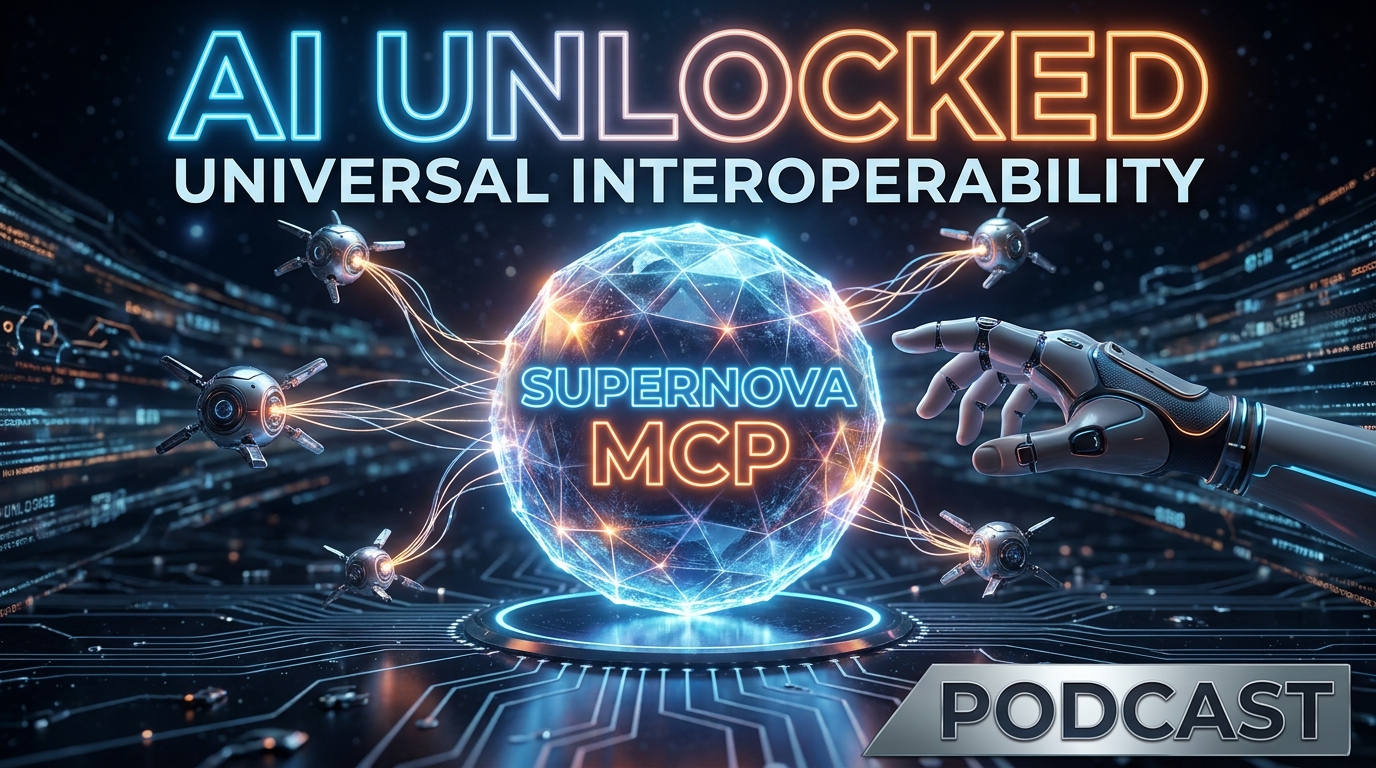
The Model Context Protocol (MCP) by Supernova represents a foundational shift in AI system design, directly addressing the pervasive challenge of fragmentation. By standardizing the exchange of contextual information and abstracting model-specific nuances, MCP enables seamless communication and collaboration among disparate AI models and autonomous agents. This universal interoperability is critical for building scalable, resilient, and intelligent multi-agent systems, positioning Supernova at the forefront of orchestrating the next generation of AI.
In an increasingly complex digital landscape, the promise of Artificial Intelligence lies not merely in isolated intelligent systems but in their collective ability to solve problems far beyond the scope of any single agent. However, the realization of this grand vision has been consistently hampered by a fundamental hurdle: the lack of a universal language and framework for AI models and agents to truly understand and interact with one another. Supernova's Model Context Protocol (MCP) emerges as the pivotal innovation designed to overcome this very challenge, fostering an era of genuinely collaborative and orchestrated AI.
The Interoperability Imperative in Autonomous AI Orchestration
The vision of truly autonomous AI systems, capable of complex problem-solving, dynamic adaptation, and proactive decision-making, inherently hinges on their ability to collaborate effectively. Imagine a future where AI entities manage smart cities, optimize global supply chains, or lead scientific discovery – such scenarios demand intricate coordination among specialized AI components. Yet, the current landscape of AI development is often characterized by silos: models trained on different datasets, developed using varying frameworks, and operating within isolated environments. This fragmentation severely limits the potential for sophisticated agent orchestration, where multiple AI entities must work in concert to achieve overarching goals.
The Foundational Challenge: Beyond Data Exchange, Towards Semantic Context
At its core, the interoperability challenge isn't just about the mechanics of data exchange, such as sending information from one service to another via an API call. It's about a deeper, more nuanced requirement: context. An autonomous agent doesn't merely need the raw output of an AI model; it critically needs to understand the underlying assumptions, the specific domain or operational context from which that data originated, the model's limitations, its confidence in its output, and the overall relevance of that data to the agent's current task or goal. Without a standardized, rich way to convey this contextual metadata, agents are left to interpret disparate outputs in isolation, leading to a cascade of inefficiencies and potential failures:
- Semantic Mismatches: Different models, even when operating in similar domains, may use the same term with different implied meanings, or conversely, use different terms to describe the same concept. For example, 'customer satisfaction score' might refer to a 1-5 scale in one system and a 0-100 percentage in another. Without explicit context, an agent cannot reliably interpret or aggregate such data.
- Data Format and Schema Incompatibilities: The myriad of data schemas, serialization formats (e.g., JSON, XML, Protobuf), and data structures across different AI models and platforms creates constant integration hurdles. Custom parsers and translators become necessary for every new connection, leading to brittle and maintenance-heavy systems.
- Lack of Shared State Awareness: Agents struggle to maintain a coherent, unified understanding of the overall system's state or the collective progress towards a goal when interacting with models that lack shared contextual information. This prevents sophisticated multi-step reasoning and dynamic resource allocation.
- Scaling Bottlenecks: Each new AI model or agent introduced into an ecosystem typically requires bespoke integration logic, extensive data mapping, and custom contextual bridges. This "N-squared" problem of integration complexity rapidly becomes unmanageable as systems grow, stifling innovation and scalability.
- Fragile Orchestration and Debugging Nightmares: Changes in one component's data output, model version, or underlying assumptions can ripple unpredictably through the entire system, requiring extensive re-engineering, re-testing, and debugging. Diagnosing the root cause of an error in a loosely coupled, context-poor multi-agent system is exceptionally difficult.
These challenges collectively prevent the agile development, robust deployment, and effective operation of multi-agent systems, particularly in enterprise environments where diverse AI capabilities must integrate seamlessly into existing, complex workflows and legacy systems.
Insight: Beyond APIs – The Need for Semantic Protocols
While Application Programming Interfaces (APIs) are fundamental to modern software development, defining how systems communicate by specifying endpoints, request/response formats, and protocols, they often fall short in defining what is being communicated in a semantically consistent and universally understandable way. Traditional APIs are excellent for transactional interactions but typically lack the inherent mechanism to convey the rich, dynamic context necessary for intelligent AI collaboration. The Model Context Protocol (MCP) goes fundamentally beyond mere API standardization; it focuses on establishing a shared understanding of context – a common "language for intelligence" – which is paramount for genuine, sophisticated AI collaboration, rather than just facilitating data pipes.
How Supernova's Model Context Protocol (MCP) Addresses Fragmentation
Supernova's Model Context Protocol (MCP) is engineered to be the connective tissue for heterogeneous AI systems, transforming a fragmented landscape into a cohesive, collaborative ecosystem. It introduces a revolutionary approach by standardizing the way AI models and autonomous agents exchange and interpret contextual information. Crucially, MCP doesn't dictate how an AI model should be built, trained, or internally operate; rather, it dictates how its output, its input requirements, its operational characteristics, and its inherent biases or limitations are described, understood, and utilized across a distributed AI ecosystem.
Test Agent Primitive
See the concepts from this article in action. No login required.
Standardizing Contextual Exchange for Universal Understanding
MCP defines a universal, extensible schema for context. This isn't just about defining basic data fields; it encompasses a comprehensive set of metadata crucial for intelligent decision-making and collaboration. This metadata includes, but is not limited to:
- Data Provenance: Where did the input data come from? What transformations has it undergone?
- Confidence Scores: How certain is the model about its output? What is the probability of its prediction being correct?
- Temporal Relevance: When was the data generated or last updated? Is it still valid for the current time frame?
- Spatial Attributes: If applicable, what are the geographical or physical coordinates associated with the data or event?
- Ethical Guardrails and Constraints: What ethical principles or regulatory compliance requirements govern the model's operation or data usage? Are there specific use restrictions?
- Model Identity and Versioning: Which specific model (and version) produced this output? This is crucial for auditability and reproducibility.
- Input Requirements and Constraints: What kind of input does the model expect, and what are its limitations (e.g., maximum length, data types)?
- Model's 'Understanding' or 'Intention': What was the model attempting to achieve with its output? What is its inherent bias or operational scope?
- Semantic Tags and Ontologies: Rich semantic descriptors that link data points to broader knowledge graphs, enabling deeper understanding.
By adopting a common contextual language, such as extensions of JSON-LD or OWL ontologies, MCP ensures that an autonomous agent receiving an output from a Computer Vision model, for instance, understands not just 'object detected: car', but also 'confidence: 98%', 'detection area: [x,y,w,h]', 'model version: 2.1.3', 'ethical consideration: public space monitoring (adheres to GDPR)', 'source sensor: CCTV-Cam-007', and 'next expected action: anomaly detection system triggered'. This rich, standardized context is crucial for intelligent decision-making, enabling agents to reason about the data in a meaningful way, not just process it blindly.
Abstracting Model Specifics for Seamless Integration
A significant hurdle in current AI integration practices is the sheer diversity of model types—from large language models (LLMs) and computer vision (CV) models to traditional machine learning (ML) algorithms (e.g., random forests, SVMs), reinforcement learning agents, and generative AI models. Each often comes with its own unique data formats, computational requirements, and operational paradigms. MCP elegantly solves this by providing a layer of abstraction.
Instead of requiring agents to understand the internal workings or specific API signatures of every individual model, MCP defines a universal interface for interacting with any AI capability. This abstraction layer translates model-specific inputs and outputs into the standardized MCP context format, and vice-versa. This means an agent can request a "sentiment analysis" task, for example, without needing to know if the underlying model is a BERT-based LLM, a recurrent neural network, or a simpler lexicon-based algorithm. The MCP handles the necessary translation and contextualization.
This abstraction extends to diverse frameworks (e.g., PyTorch, TensorFlow, Scikit-learn), programming languages (Python, Java, C++), and deployment environments (cloud, edge, on-premise). Essentially, MCP acts as a universal adapter, making any AI model accessible and understandable to any other AI agent or system that speaks MCP.
Architectural Components of the Model Context Protocol (MCP)
To achieve its universal interoperability goals, MCP is built upon several key architectural components that work in concert:
- Context Registries: Centralized or distributed repositories that store the standardized contextual metadata (schemas, ontologies, model capabilities, ethical guidelines) for all registered AI models and agents within an ecosystem. This acts as a 'yellow pages' for AI capabilities.
- Semantic Resolvers: Components responsible for interpreting and translating requests and responses between different AI entities, ensuring that semantic ambiguities are resolved based on the shared MCP ontologies. They translate agent queries into model-specific calls and model outputs into agent-consumable context.
- Standardized Context Payloads: The defined data structures (e.g., JSON-LD, OWL-based structures) that encapsulate all relevant contextual information alongside the core data, enabling rich, unambiguous communication.
- Message Brokers/Communication Layer: While MCP defines the content of the message, it leverages robust message queuing and streaming technologies (e.g., Kafka, RabbitMQ) for efficient, asynchronous, and scalable delivery of these contextual payloads between distributed agents and models.
- Policy and Governance Engine: Integrated mechanisms to enforce ethical guardrails, access control, data privacy regulations, and operational policies, ensuring AI interactions are compliant and responsible.
Comparative Advantage: Traditional Integration vs. MCP Integration
To highlight the transformative impact of Supernova's MCP, consider the stark differences in approach and outcomes when integrating AI models:
| Feature | Traditional AI Integration (API-centric) | MCP-driven AI Integration |
|---|---|---|
| Core Focus | Data exchange via API calls; syntax-level communication. | Semantic understanding & contextual information exchange; meaning-level communication. |
| Integration Complexity | High; N-squared problem with custom wrappers, translators, and data mapping for each pair. | Low; standardized interface abstracts model specifics, reducing bespoke integration logic. |
| Scalability | Limited; becomes unmanageable as the number of models/agents grows. Bottlenecks due to custom logic. | High; new models/agents can join the ecosystem quickly by adhering to MCP standards. |
| Interoperability Level | Basic; limited to predefined data formats and operational assumptions. Fragile. | Universal; enables deep, meaningful collaboration across diverse models and platforms. Robust. |
| Contextual Awareness | Low; context often implicit or narrowly defined, leading to misinterpretations. | High; rich, standardized metadata (provenance, confidence, ethical context) for informed decisions. |
| Development Cycle | Slow; significant time spent on integration and debugging. | Accelerated; developers focus on AI logic, not integration plumbing. |
| System Resilience | Low; changes in one component can easily break others due to tight coupling. | High; decoupled architecture with clear contextual contracts makes systems more robust to changes. |
Benefits of Universal Interoperability Enabled by MCP
The implications of MCP's universal interoperability extend far beyond technical elegance, delivering tangible benefits across various dimensions:
- Accelerated AI Development and Deployment: Developers can focus on building innovative AI models rather than wrestling with integration complexities. This drastically reduces time-to-market for new AI-powered solutions.
- Enhanced Collaboration Among AI Agents: MCP fosters sophisticated multi-agent systems where AI entities can dynamically form teams, share insights, and collectively achieve complex goals that were previously unattainable for isolated AIs.
- Improved System Reliability and Resilience: By standardizing context and abstracting model specifics, systems become less brittle. Changes or failures in one component can be more easily isolated and managed, leading to more robust and fault-tolerant AI ecosystems.
- Cost Reduction: Significant savings are realized by minimizing the need for custom integration code, specialized middleware, and extensive debugging efforts. Operational efficiency is greatly improved.
- Unlocking New AI Capabilities and Use Cases: True interoperability opens the door to entirely new paradigms of AI applications, such as dynamic AI marketplaces, adaptive learning systems that combine disparate intelligence, and highly personalized autonomous services.
- Simplified Governance and Compliance: The inclusion of ethical guardrails, provenance, and model versioning within the standardized context makes it easier to track, audit, and ensure compliance with regulatory requirements.
Real-World Applications and Transformative Use Cases
The transformative potential of MCP-orchestrated autonomous agents is vast, spanning numerous industries:
- Healthcare: Imagine diagnostic AI models (e.g., for radiology, pathology) collaborating with treatment planning AIs, patient monitoring agents, and drug discovery LLMs. MCP would enable seamless data flow and contextual understanding across these highly specialized systems, leading to more accurate diagnoses, personalized treatments, and accelerated research. For instance, an agent analyzing patient vitals could pass its findings, along with confidence scores and sensor data provenance, to a diagnostic agent, which in turn informs a treatment recommendation agent, all while adhering to strict privacy protocols defined within the context.
- Manufacturing and Industry 4.0: Autonomous robots on a factory floor could share contextual information from their vision systems, sensor arrays, and predictive maintenance models. MCP would allow them to coordinate complex assembly tasks, dynamically adapt to supply chain disruptions, and predict equipment failures with unprecedented precision, all communicating in a common, semantically rich language.
- Financial Services: Fraud detection AI, algorithmic trading bots, customer service LLMs, and regulatory compliance agents could operate as a unified intelligence. MCP would enable real-time sharing of market sentiment (from LLMs), transaction patterns (from ML models), and risk assessments, ensuring rapid, informed decision-making while adhering to strict financial regulations and audit trails.
- Smart Cities: Traffic management AIs, public safety agents, environmental monitoring systems, and utility grid optimizers could all communicate effectively. MCP would facilitate the integration of diverse data sources (e.g., traffic cameras, air quality sensors, weather forecasts) and AI models, enabling proactive urban planning, emergency response, and resource allocation.
- Supply Chain Optimization: AI agents managing inventory, logistics, demand forecasting, and supplier relationship management can achieve unprecedented efficiency. MCP enables these agents to share real-time updates on stock levels, shipping delays, geopolitical risks, and customer demand shifts, allowing the entire supply chain to react dynamically and autonomously.
The Road Ahead: Future Implications and Scalability
Supernova's MCP is more than just a protocol; it is a strategic enabler for the next generation of AI. It lays the groundwork for:
- Emergence of General AI (AGI): By facilitating complex, context-aware collaboration, MCP brings us closer to systems capable of human-like reasoning and problem-solving across diverse domains. It provides the necessary infrastructure for diverse intelligences to aggregate and synthesize knowledge.
- Robust Multi-Agent Ecosystems: It allows for the organic growth and evolution of AI ecosystems, where new agents and models can be seamlessly integrated, fostering innovation and specialization. This creates a vibrant marketplace of AI services that can dynamically compose themselves to solve novel problems.
- Ethical and Trustworthy AI: With explicit contextual elements for ethical considerations and provenance, MCP provides a robust framework for building and governing AI systems that are transparent, accountable, and aligned with human values. This is crucial as AI takes on more critical roles in society.
- Decentralized AI Architectures: MCP can thrive in decentralized environments, allowing for secure, peer-to-peer AI collaboration without relying on single points of control, enhancing resilience and privacy.
The ability to orchestrate autonomous agents at scale is no longer a distant aspiration but an immediate imperative. Supernova's Model Context Protocol offers the definitive solution, moving the AI industry from fragmented intelligence to a universally interconnected, collaboratively intelligent future.
Implementing MCP: A Strategic Imperative for Enterprises
For enterprises looking to harness the full potential of AI, adopting a protocol like MCP is not just an upgrade; it's a strategic imperative. It allows organizations to:
- Maximize ROI from AI Investments: By making existing and future AI models interoperable, enterprises can get more value from their current AI infrastructure and avoid vendor lock-in.
- Foster Internal AI Innovation: Teams can more easily share and integrate AI capabilities across departments, breaking down internal silos and fostering a culture of collaborative innovation.
- Future-Proof AI Strategy: An MCP-driven architecture provides the flexibility and adaptability needed to incorporate emerging AI technologies and respond rapidly to changing business requirements.
Embracing Supernova's Model Context Protocol means moving towards an AI future that is not just smarter, but truly synergistic, scalable, and sustainable.
Ready to Build?
Stop guessing. Start building. Every new account gets 1,000 NOVA credits instantly upon login to test the registry and route intents.
Claim 1,000 Credits →