Zero-Trust Wasm: Pioneering Secure Enterprise AI Agents in Autonomous Infrastructure with Supernova
The enterprise landscape is undergoing a profound transformation. Autonomous AI agents, capable of independent decision-making, learning, and interaction with critical systems, are moving from theoretical concepts to operational realities. These agents promise unprecedented levels of automation, efficiency, and intelligence across various business functions—from complex financial trading algorithms and supply chain optimizers to intelligent customer service bots and real-time threat detection systems. Yet, their very autonomy introduces a new, intricate layer of security challenges that traditional models are ill-equipped to handle.
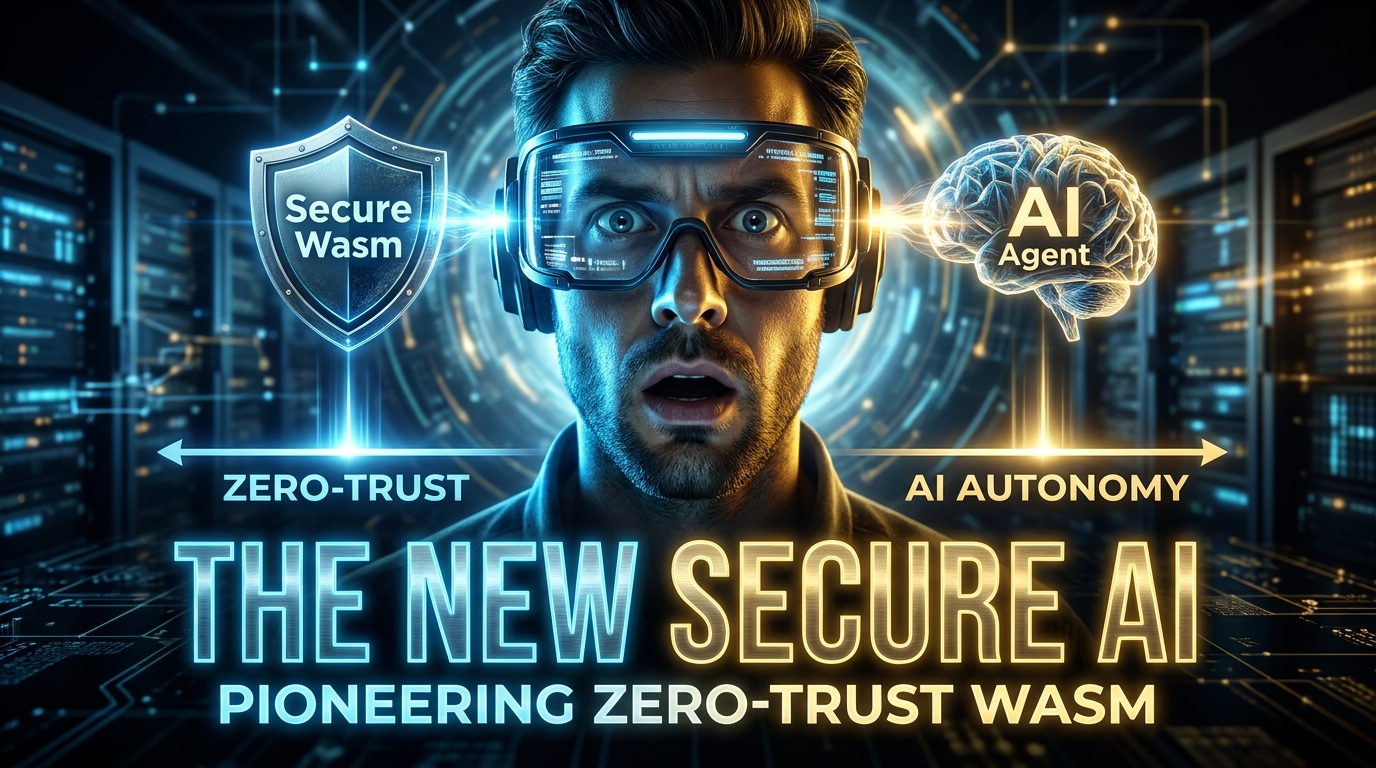
As these agents permeate sensitive enterprise infrastructure, the imperative for an unassailable security posture becomes paramount. This is where the convergence of Zero Trust principles and WebAssembly (Wasm) emerges as a game-changer. Together, they form ‘Zero-Trust Wasm’ – a pioneering paradigm for securing enterprise AI agents in dynamic, autonomous environments. Supernova stands at the forefront of this revolution, providing the foundational technology to build and run these next-generation secure AI systems.
The New Frontier: Autonomous AI Agents in Enterprise
Autonomous AI agents are not merely sophisticated scripts; they are intelligent entities often powered by Large Language Models (LLMs) or complex reinforcement learning algorithms, designed to operate with minimal human intervention. They interact with APIs, databases, external services, and even other agents, making decisions that can have significant operational and financial impacts. Examples include:
- Financial Agents: Executing trades, managing portfolios, detecting fraud.
- Supply Chain Agents: Optimizing logistics, predicting demand, managing inventory.
- IT Operations Agents: Proactively identifying system anomalies, automating incident response, managing cloud resources.
- Customer Service Agents: Resolving complex queries, personalizing interactions, escalating issues intelligently.
Unique Security Risks Posed by Autonomous AI Agents
The inherent capabilities of AI agents introduce novel and magnified security vulnerabilities:
- Expanded Attack Surface: Each agent's interaction point (APIs, data sources, communication channels) becomes a potential vector for exploitation.
- Data Exfiltration and Tampering: Agents often process and access vast amounts of sensitive data. A compromised agent could lead to catastrophic data breaches or manipulation.
- Privilege Escalation: If an agent gains unauthorized access or its permissions are exploited, it can move laterally through systems, escalating privileges to critical infrastructure components.
- AI Supply Chain Vulnerabilities: The foundational models, training data, and libraries used to build agents can be compromised before deployment, introducing backdoors or malicious behavior at the source.
- Prompt Injection and Adversarial Attacks: For LLM-based agents, crafted malicious inputs can force unintended actions, bypass safety protocols, extract confidential information, or lead to misrepresentations.
- Non-Deterministic Behavior: Unlike traditional software, AI agents can exhibit emergent behaviors that are difficult to predict, verify, and secure within static policy frameworks.
- Autonomous Malicious Actions: A hijacked agent could autonomously initiate destructive or unauthorized actions, making detection, containment, and recovery challenging due to its self-directed nature.
The Inadequacy of Traditional Security Models
Traditional perimeter-based security, which assumes everything inside the network is trustworthy, is fundamentally flawed for autonomous AI agents. These agents often operate across highly distributed environments—from on-premise data centers to multiple cloud providers and edge devices. A breach at any point can compromise the entire chain. Even robust containerization or virtualization, while offering some isolation, often carries significant operational overhead and doesn't inherently enforce fine-grained, least-privilege access across dynamic agent interactions. These approaches frequently grant more permissions than strictly necessary, creating larger attack vectors.
“Trust is a vulnerability. Zero Trust removes implicit trust from every interaction, making explicit verification the cornerstone of security for dynamic, autonomous systems.”
Contextual SandboxTest Agent Primitive
See the concepts from this article in action. No login required.
Awaiting command...
The sheer velocity, volume, and complexity of interactions an AI agent performs demand a security model that can adapt in real-time, authenticate every request, and authorize every action, regardless of its origin or location. This real-time, granular enforcement is precisely the domain of Zero Trust.
Zero Trust: The Guiding Principle for AI Security
Originating from the concept of "never trust, always verify," Zero Trust mandates that no user, device, application, or system should be implicitly trusted, regardless of whether it's inside or outside the network perimeter. Every request for access to a resource must be explicitly authenticated and authorized based on a dynamic assessment of contextual factors. This principle is codified in standards such as NIST SP 800-207, which provides a comprehensive framework for implementing Zero Trust architectures.
Core Tenets of Zero Trust Applied to AI Agents:
- Explicit Verification: Every access request from an AI agent, whether to data, an API, or another agent, must be authenticated and authorized. This includes verifying agent identity, assessing system posture, evaluating environmental context (e.g., location, time), and the sensitivity of the resource being accessed.
- Least Privilege Access: AI agents are granted only the absolute minimum access rights required to perform their current task, and these rights are continuously re-evaluated. This significantly limits the blast radius and potential damage of a compromised agent.
- Assume Breach: Security controls are designed with the assumption that a breach is inevitable or has already occurred. This leads to continuous monitoring, micro-segmentation, and rapid response capabilities to detect and contain threats quickly.
- Micro-segmentation: Decomposing AI systems into granular, isolated components (e.g., individual agent capabilities, specific data access modules, external API connectors), each protected by its own distinct security policies.
- End-to-End Encryption: All communications, both internal (agent-to-agent, agent-to-service) and external, are encrypted to prevent eavesdropping, data tampering, and ensure confidentiality and integrity.
- Continuous Monitoring: Real-time visibility into agent behavior, access patterns, resource utilization, and deviations from baselines is crucial to detect anomalies and potential threats immediately, enabling proactive security responses.
WebAssembly (Wasm): The Execution Engine of Choice
While Zero Trust defines the 'what' of securing AI agents, WebAssembly provides the 'how' – a secure, efficient, and portable runtime environment specifically engineered for modern, distributed applications. Originally designed for web browsers to enable high-performance client-side code, Wasm has rapidly evolved into a universal binary instruction format and a powerful execution engine for server-side, edge, and embedded environments.
Why Wasm is Ideal for Securing AI Agents:
- Security by Design (Sandboxing): Wasm modules execute in a secure, isolated sandbox, completely decoupled from the host operating system. They cannot directly access host files, network interfaces, or memory unless explicitly granted capabilities via a well-defined interface (WASI - WebAssembly System Interface). This inherent isolation drastically reduces the attack surface for AI agents, making them intrinsically more secure.
- Portability and Determinism: Wasm binaries are highly portable, allowing AI agents to run consistently across any environment—cloud, edge, on-premise, different operating systems, and architectures—without recompilation. This determinism is critical for verifying agent behavior and ensures consistent security enforcement across all deployment targets.
- Performance and Efficiency: Wasm executes at near-native speeds, often outperforming traditional containers for certain workloads due to its lightweight nature and efficient startup times (milliseconds). This is vital for AI agents requiring low-latency responses and high computational throughput without incurring significant resource overhead.
- Small Footprint: Wasm modules are compact, leading to faster deployments, lower memory consumption, and improved scalability, especially for a multitude of ephemeral AI agents or edge deployments with limited resources.
- Polyglot Support: Developers can write AI agent logic in a multitude of preferred languages (Rust, Go, C/C++, Python via bindings, AssemblyScript, etc.) and compile them down to Wasm. This leverages existing skill sets and libraries while benefiting from Wasm’s superior security and performance characteristics.
- Capability-Based Security: Wasm allows for explicit declaration of what a module can and cannot do. This fine-grained control perfectly aligns with Zero Trust's least privilege principle, ensuring agents only have access to the specific resources and operations they unequivocally require.
To illustrate the advantages, consider a comparison between Wasm and other common execution environments for AI agents:
| Feature | WebAssembly (Wasm) | Docker Containers | Virtual Machines (VMs) |
|---|---|---|---|
| Security Model | Secure by design, capability-based sandboxing, no direct OS access. | OS-level isolation (shared kernel), namespace/cgroups; potential for kernel exploits or container escapes. | Hardware-level virtualization, strong isolation; larger attack surface (full OS). |
| Runtime Overhead | Extremely low, near-native performance, rapid startup (<10ms). | Moderate, shared kernel, faster startup than VMs (seconds). | High, full OS emulation, slower startup (minutes). |
| Portability | Universal binary, runs anywhere with a Wasm runtime (cloud, edge, browser). | Container engine dependent, OS/architecture limitations. | Requires hypervisor, specific OS images. |
| Footprint | Minimal, small binaries (KBs), low memory consumption. | Moderate, includes application + OS dependencies (MBs to GBs). | Large, full OS image (GBs). |
| Typical Use Case for AI Agents | Edge inference, serverless functions, micro-agents, highly secure & performant autonomous systems, real-time decision-making. | Batch processing, larger ML models, traditional microservices, stateful applications. | Dedicated ML training, sensitive data processing, legacy systems, high compliance environments needing full OS control. |
Unifying Zero Trust and Wasm: Zero-Trust Wasm for AI Agents
The true power emerges when Zero Trust principles are deeply integrated into the WebAssembly execution model. Zero-Trust Wasm creates an environment where every AI agent, every module, and every interaction is treated as potentially hostile and subject to continuous, rigorous verification. It’s not just about isolating agents; it's about making their execution inherently secure and verifiable, building trust through relentless validation.
How Zero-Trust Wasm Secures Autonomous AI Infrastructures:
- Micro-segmentation at the Agent Level: Each AI agent, or even specific functions within an agent (e.g., data ingestion, decision logic, action execution), can be deployed as independent Wasm modules. This creates atomic, isolated units, each with its own capabilities and policies. A compromise in one module does not automatically cascade to others, effectively limiting lateral movement.
- Fine-grained, Capability-Based Authorization: Instead of broad network rules, Zero-Trust Wasm leverages Wasm’s capability-based security model. An agent module is explicitly granted permission for, say, "write to specific log file in directory X" or "make API call to financial service endpoint A with read-only access." Any attempt to exceed these capabilities is blocked by the Wasm runtime before it can execute.
- Runtime Policy Enforcement and Verification: Zero Trust policies are enforced directly at the Wasm runtime layer. This means every system call, every network request originating from a Wasm module is intercepted and validated against predefined policies. Deviations from expected behavior trigger immediate alerts or automatic termination of the module.
- Immutable Agent Logic: Wasm binaries, once compiled, signed, and verified, are immutable. This significantly reduces the risk of tampering or supply chain attacks post-deployment. Any update requires explicit re-deployment of new, cryptographically signed and verified Wasm modules, ensuring integrity throughout the lifecycle.
- Secure Inter-Agent Communication: When agents need to communicate, Zero-Trust Wasm ensures that communication channels are authenticated, authorized, and encrypted. This can be achieved through Wasm-specific communication protocols or by integrating with service mesh technologies that enforce Zero Trust policies on Wasm-based services, ensuring secure data exchange.
- Dynamic Contextual Access: Access policies can be dynamically adjusted based on real-time contextual data (e.g., time of day, observed behavior, source IP reputation, threat intelligence, deviation from normal operational parameters). An agent might have different permissions during business hours versus off-hours, or if suspicious activity is detected in its operating environment, allowing for adaptive security.
Supernova's Role in Empowering Zero-Trust Wasm for Enterprise AI
Supernova is pioneering the infrastructure that makes Zero-Trust Wasm a reality for enterprise AI teams. Our platform is engineered to deliver the performance, security, and scalability demanded by autonomous agents operating in critical environments. We understand the unique challenges of deploying and managing intelligent agents, and our solutions are built from the ground up to address them, providing a robust foundation for next-generation AI.
How Supernova Supports Your Secure AI Agent Strategy:
- Optimized Wasm Runtimes: Supernova provides highly optimized, secure, and performant Wasm runtimes specifically designed for enterprise-grade deployments, ensuring minimal overhead and maximum efficiency for your AI agents across diverse infrastructure.
- Advanced Policy Orchestration: Our platform enables you to define, deploy, and enforce granular Zero Trust policies for every Wasm-based AI agent, ensuring least privilege access and continuous verification. This translates into precise control over agent actions and resource access.
- Secure Deployment and Lifecycle Management: From secure CI/CD pipelines for Wasm module signing and distribution to robust runtime monitoring and automated remediation, Supernova offers comprehensive lifecycle management for your AI agents, guaranteeing integrity from build to execution.
- Seamless Integration: Integrate Zero-Trust Wasm agents with your existing enterprise systems, data sources, and cloud environments with ease, leveraging Supernova's flexible and open architecture that prioritizes interoperability.
- Observability and Auditing: Gain deep insights into agent behavior, resource utilization, and security events with Supernova's built-in observability tools. This is crucial for compliance, rapid threat detection, debugging, and understanding the operational dynamics of your autonomous systems.
By leveraging Supernova, enterprises can move beyond theoretical security frameworks and implement practical, high-performance Zero-Trust Wasm solutions that protect their autonomous AI investments against an evolving threat landscape. We empower AI developers and agent framework builders to focus on innovation, knowing their creations are running on a foundation of unparalleled security and reliability.
Challenges and Future Outlook
While Zero-Trust Wasm presents a compelling vision, its full realization requires continuous innovation and community effort. Key areas of focus include:
- Tooling Maturity: The Wasm ecosystem for enterprise-grade AI is rapidly evolving. Enhanced debugging, profiling, and introspection tools are needed for complex agent behaviors and intricate interactions within a Zero Trust framework.
- Component Model Evolution: The WebAssembly Component Model promises even greater interoperability and modularity, further enabling fine-grained security for composite agents and complex AI workflows by standardizing inter-component communication.
- Standardized AI Interfaces: Developing standardized WASI (WebAssembly System Interface) proposals for common AI operations (e.g., model inference, vector database access, natural language processing) will accelerate adoption and improve security consistency across different agent implementations.
- Integration with AI Governance: Tightly coupling Zero-Trust Wasm enforcement with broader AI governance frameworks is essential to manage risks associated with agent autonomy, mitigate bias, ensure explainability, and maintain ethical compliance.
Despite these evolving challenges, the trajectory is clear. Zero-Trust Wasm represents the logical and necessary evolution for securing enterprise AI. It moves away from reactive security patches to proactive, architectural fortification, laying the groundwork for a future where autonomous AI can operate with unprecedented trust, resilience, and verifiable integrity across the most demanding enterprise environments.
Conclusion
The advent of autonomous AI agents marks a new era for enterprise innovation, but it simultaneously ushers in a complex array of security challenges. Traditional security models are no longer sufficient to safeguard dynamic, distributed, and intelligent systems from sophisticated threats. Zero Trust provides the essential security philosophy, demanding explicit verification for every interaction, and WebAssembly offers the robust, secure, and efficient execution environment required for these next-generation workloads. The combination—Zero-Trust Wasm—is not merely an enhancement; it is a fundamental re-architecture of how we secure enterprise AI from the ground up.
Supernova is committed to pioneering this secure future, equipping enterprises with the advanced tools and infrastructure to harness the full potential of AI agents without compromising security. By adopting Zero-Trust Wasm, organizations can build autonomous AI systems that are not only powerful, efficient, and scalable but also inherently secure, verifiable, and resilient against the most sophisticated threats, truly enabling the autonomous enterprise.
Key CRE Insights
| Factor | Strategic Impact |
|---|---|
| Market Trends | High Growth Potential |
| Risk Analysis | Mitigated via Data |
Ready to Build?
Stop guessing. Start building. Every new account gets 1,000 NOVA credits instantly upon login to test the registry and route intents.
Claim 1,000 Credits →